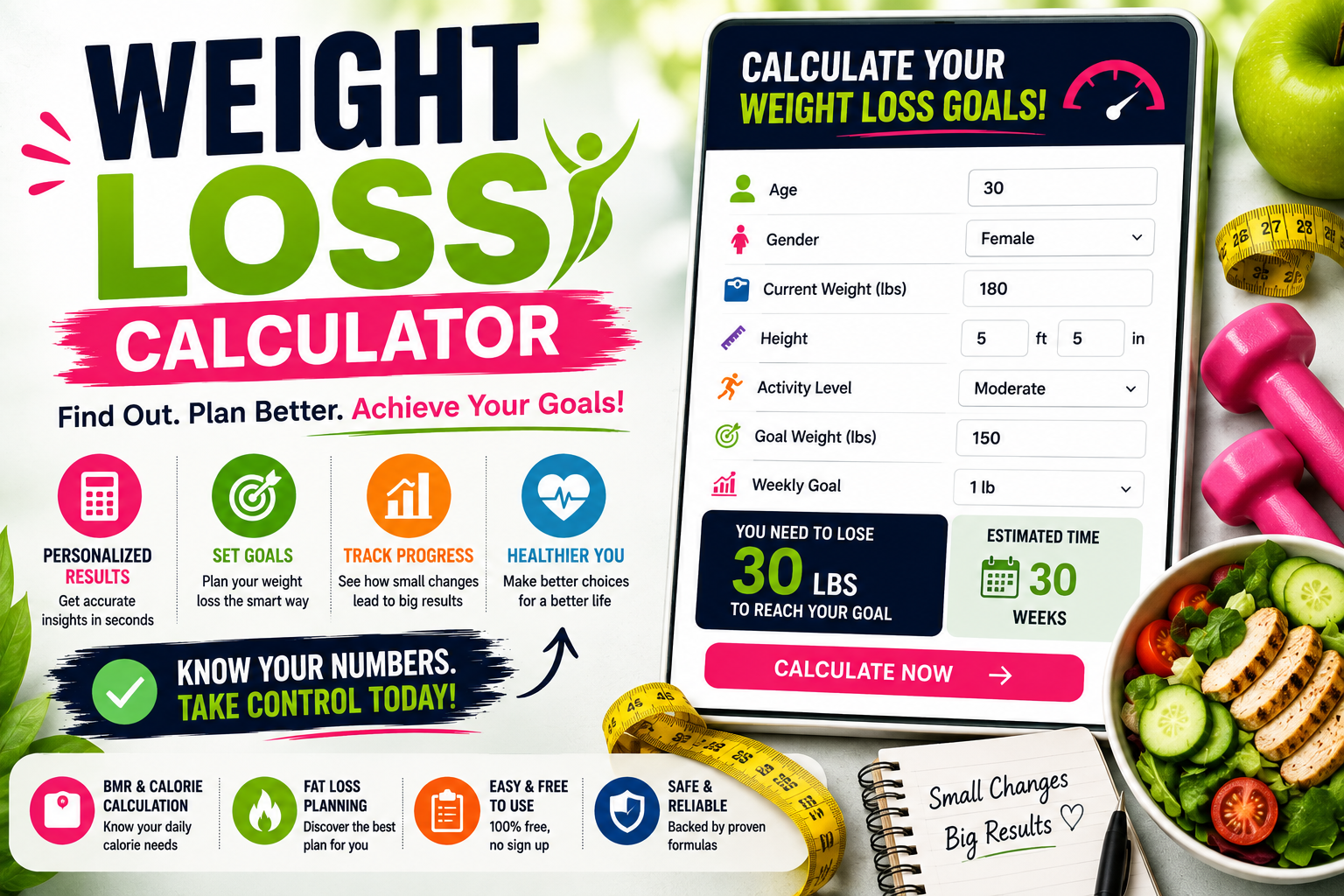
Losing weight becomes much easier when you understand how many calories your body needs and how much you may need to reduce your daily intake to reach your goal.
Our weight loss calculator can help you estimate your daily calorie needs, potential calorie deficit, and approximate timeline for reaching a target weight. Instead of guessing how much you should eat, you can use your age, sex, height, current weight, activity level, and goal weight to get a more personalized estimate.
Important: A calorie calculator provides an estimate, not a medical prescription. Your actual calorie needs can vary based on metabolism, body composition, health conditions, medications, and activity levels.
Weight Loss Calculator
Calorie Calculator : https://www.calculator.net/calorie-calculator.html
Enter your information below to estimate your daily calorie needs.
Age:
Enter your age in years.
Sex:
- Male
- Female
Height:
Enter your height in centimeters or feet/inches.
Current Weight:
Enter your current weight in kilograms or pounds.
Goal Weight:
Enter the weight you would like to reach.
Activity Level:
- Sedentary: Little or no exercise
- Lightly Active: Exercise 1–3 days per week
- Moderately Active: Exercise 3–5 days per week
- Very Active: Exercise 6–7 days per week
- Extra Active: Very hard exercise or physically demanding work
What the Calculator Estimates
Your results can include:
BMR: Estimated calories your body uses at rest.
TDEE: Estimated calories you burn each day based on your activity.
Weight-Loss Calories: An estimated calorie target based on a moderate deficit.
Estimated Weekly Weight Loss: An approximate rate based on the selected calorie deficit.
Estimated Goal Date: An approximate timeframe for reaching your target weight.
How Does a Weight Loss Calculator Work?
A weight loss calculator generally starts by estimating your Basal Metabolic Rate (BMR).
BMR represents the approximate amount of energy your body needs to perform basic functions while at rest, such as breathing, circulation, and maintaining body temperature.
The calculator can then use your activity level to estimate your Total Daily Energy Expenditure (TDEE).
In simple terms:
BMR → Activity → Estimated Daily Calorie Needs → Calorie Deficit → Potential Weight Loss
For example, if someone maintains their weight at approximately 2,400 calories per day, eating fewer calories than that over time may result in weight loss.
However, weight loss isn’t perfectly linear. As body weight changes, energy requirements can change as well.
What Is a Calorie Deficit?
A calorie deficit occurs when you consume fewer calories than your body uses.
For example:
- Estimated maintenance: 2,400 calories
- Food intake: 1,900 calories
- Estimated deficit: 500 calories
This doesn’t mean every day will produce exactly the same amount of weight loss.
Water retention, glycogen, sodium intake, digestion, hormonal changes, activity, and other factors can cause the number on the scale to move up and down.
That’s why it’s generally more useful to look at long-term trends rather than judging progress from a single day’s weight.
How Many Calories Should You Eat to Lose Weight?
There isn’t one calorie number that works for everyone.
Your calorie needs depend on factors such as:
- Age
- Sex
- Height
- Weight
- Muscle mass
- Daily activity
- Exercise
- Overall health
A calculator can provide an estimate, but your actual results should be monitored over time.
A moderate calorie reduction is generally more sustainable than trying to lose weight as quickly as possible.
Very aggressive calorie restriction can make it harder to meet nutritional needs and maintain muscle mass.
What Is BMR?
BMR stands for Basal Metabolic Rate.
It is an estimate of the energy your body requires to maintain basic physiological functions at rest.
Your BMR is influenced by several factors, particularly:
- Body size
- Age
- Sex
- Body composition
Someone with a larger body or greater amount of lean mass may have a higher resting energy expenditure than someone with a smaller body.
Your BMR is not the number of calories you should automatically eat every day because your body also burns calories through movement, exercise, digestion, and other activities.
What Is TDEE?
TDEE stands for Total Daily Energy Expenditure.
It represents an estimate of the total calories you burn during an average day.
TDEE includes energy used for:
- Basic body functions
- Walking and movement
- Exercise
- Digestion
- Daily activities
A common approach is to estimate BMR and then multiply it by an activity factor.
This produces an approximate maintenance-calorie level.
Why Your Weight Loss May Not Match the Calculator
Even an accurate mathematical calculation cannot perfectly predict how your body will respond.
Your actual results may differ because:
Water Weight Changes
Changes in sodium, carbohydrates, hormones, and hydration can temporarily affect scale weight.
Metabolic Adaptation
As your body weight decreases, your energy requirements may also decrease.
Activity Changes
People sometimes unconsciously move less when eating fewer calories.
Tracking Errors
Portion sizes, cooking oils, sauces, beverages, and snacks can make actual calorie intake higher than estimated.
Individual Differences
Two people with the same age, height, and weight can have different energy requirements.
For this reason, treat calculator results as a starting estimate, not a guarantee.
How Long Does It Take to Lose Weight?
The answer depends on your starting weight, calorie deficit, activity, diet, and individual response.
A common sustainable target used in weight-management guidance is around 1–2 pounds per week for many adults, although appropriate rates vary considerably.
For example, someone trying to lose 20 pounds shouldn’t assume that a calculator can guarantee exactly 10 weeks.
A more realistic approach is to establish a reasonable calorie target, follow it consistently, monitor your trend, and adjust when necessary.
How to Use a Weight Loss Calculator Correctly
A calculator is only as useful as the information you enter. For a better estimate, use your current weight, accurate height, age, and a realistic description of your usual activity.
Step 1: Enter Your Age
Age can affect estimated calorie requirements because energy expenditure tends to change as people get older.
Use your current age rather than your age at the beginning of your weight-loss journey.
Step 2: Select Your Sex
Most standard calorie equations use sex as one of their inputs because average body composition and energy expenditure differ between males and females.
This is an estimate rather than a statement about an individual’s metabolism.
Step 3: Enter Your Height
Enter your actual height as accurately as possible.
You can use either:
- Centimeters
- Feet and inches
Avoid estimating your height if you can measure it.
Step 4: Enter Your Current Weight
Use your current body weight.
If your weight fluctuates from day to day, don’t worry about a small difference. For tracking progress, weighing yourself under similar conditions can make trends easier to interpret.
Step 5: Enter Your Goal Weight
Your goal weight helps the calculator estimate how much weight you want to lose.
For example:
Current weight: 200 lb
Goal weight: 170 lb
Weight to lose: 30 lb
Your target should be realistic and appropriate for your individual circumstances.
Step 6: Select Your Activity Level
This is one of the most important inputs.
Be honest rather than choosing the highest activity category because you exercise occasionally.
Activity Levels Explained
Sedentary
Choose this if you spend most of the day sitting and get little structured exercise.
Examples include:
- Desk-based work
- Minimal walking
- Little or no exercise
Lightly Active
This may describe someone who walks regularly or performs light exercise several times per week.
Examples include:
- Walking
- Light cycling
- Casual exercise
- Light recreational activities
Moderately Active
This generally means regular exercise or fairly active daily movement.
Examples include:
- Moderate workouts several days per week
- Regular sports
- Active jobs combined with exercise
Very Active
This category may apply to people who exercise intensely most days or have physically demanding lifestyles.
Extra Active
This is generally reserved for people with very high physical activity, such as strenuous training combined with physically demanding work.
Choosing an activity level that is too high can make your estimated maintenance calories unrealistically large.
Weight Loss Calculator Formula
Many calorie calculators use the Mifflin-St Jeor equation to estimate BMR.
For men:
BMR = (10 × weight in kg) + (6.25 × height in cm) − (5 × age) + 5
For women:
BMR = (10 × weight in kg) + (6.25 × height in cm) − (5 × age) − 161
The estimated BMR is then multiplied by an activity factor to estimate TDEE.
Typical activity multipliers are approximately:
| Activity Level | Example Factor |
|---|---|
| Sedentary | 1.2 |
| Lightly Active | 1.375 |
| Moderately Active | 1.55 |
| Very Active | 1.725 |
| Extra Active | 1.9 |
These values are estimates, not exact measurements.
Example Weight Loss Calculation
Imagine a hypothetical 35-year-old person who is:
- 5’7″ tall
- 180 pounds
- Moderately active
- Goal weight: 150 pounds
The calculator first converts the measurements into the units required by the equation.
It then estimates:
- BMR
- TDEE
- Estimated maintenance calories
- A reasonable calorie-deficit range
- Approximate weight-loss timeline
The exact result depends on the person’s sex and other inputs.
This illustrates why simply searching for “how many calories should I eat to lose weight?” isn’t enough. A personalized estimate requires several pieces of information.
What Is a Good Calorie Deficit?
A calorie deficit doesn’t need to be extreme.
For many people, a moderate deficit may be easier to maintain than a very large one.
For example, if estimated maintenance is:
2,500 calories/day
A person might choose a moderate reduction such as:
2,000–2,250 calories/day
The appropriate amount varies between individuals.
Your calorie target should still allow you to obtain adequate protein, essential fats, vitamins, minerals, fiber, and other nutrients.
Why Bigger Calorie Deficits Aren’t Always Better
It may seem logical that eating dramatically fewer calories would produce dramatically faster weight loss.
But aggressive restriction can create problems.
You may experience:
- Increased hunger
- Low energy
- Difficulty exercising
- Poor adherence
- Loss of lean mass
- Increased cravings
- Difficulty meeting nutritional needs
A plan that you can follow consistently is usually more useful than a highly restrictive plan that lasts only a few days.
How Protein Can Support Weight Loss
Protein is particularly useful when you’re trying to lose weight.
It helps provide essential amino acids and supports the maintenance of muscle tissue.
Good protein-rich foods include:
- Eggs
- Chicken
- Turkey
- Fish
- Greek yogurt
- Cottage cheese
- Beans
- Lentils
- Tofu
- Edamame
Try to include a protein source in your major meals.
For example:
Breakfast: Eggs + vegetables
Lunch: Chicken + salad + whole grains
Dinner: Fish + vegetables + potatoes
Snack: Greek yogurt + berries
Don’t Forget Fiber
Fiber can help make meals more filling while supporting digestive health.
Good sources include:
- Beans
- Lentils
- Chickpeas
- Oats
- Berries
- Apples
- Vegetables
- Chia seeds
- Flaxseeds
- Whole grains
Instead of simply cutting calories, replace some lower-fiber foods with foods that provide more fiber and nutrients.
Foods That Can Make Weight Loss Easier
A useful weight-loss diet doesn’t have to be boring.
Build meals around foods such as:
Protein
- Eggs
- Chicken
- Fish
- Greek yogurt
- Tofu
- Beans
Vegetables
- Spinach
- Broccoli
- Cauliflower
- Tomatoes
- Cucumbers
- Peppers
Fruits
- Berries
- Apples
- Oranges
- Bananas
- Melons
Whole Grains
- Oats
- Brown rice
- Quinoa
- Barley
- Whole-wheat bread
Healthy Fats
- Avocado
- Nuts
- Seeds
- Olive oil
Portion size still matters because even nutritious foods contribute calories.
What Should You Drink During Weight Loss?
Drinks can contribute a surprising amount of calories.
Good everyday choices include:
- Water
- Sparkling water
- Unsweetened tea
- Unsweetened coffee
You don’t necessarily have to eliminate every calorie-containing beverage, but reducing sugary drinks can be an easy way to lower calorie intake.
Examples of drinks that can add substantial calories include:
- Regular soda
- Sweetened coffee drinks
- Energy drinks
- Sugary juices
- Milkshakes
Whole fruit is generally more filling than drinking fruit juice because whole fruit contains fiber and requires chewing.
Weight Loss Calculator vs. BMI Calculator
These calculators answer different questions.
BMI Calculator
BMI uses height and weight to estimate a person’s weight category.
Weight Loss Calculator
A weight-loss calculator estimates calorie requirements and potential weight-loss goals based on several factors.
BMI can be one useful screening tool, but it doesn’t directly measure body fat or distinguish between muscle and fat.
For example, a muscular person may have a relatively high BMI without having excess body fat.
Therefore, BMI should be interpreted in context.
How Often Should You Weigh Yourself?
There isn’t one perfect frequency.
Some people prefer daily measurements because they can calculate a longer-term trend. Others find weekly measurements easier.
If you weigh yourself, try to keep conditions similar:
- Similar time of day
- Similar clothing
- Similar scale
- Similar routine
Don’t panic about a one-day increase.
Your weight can temporarily rise because of:
- Water retention
- Sodium
- Carbohydrate intake
- Food still being digested
- Hormonal changes
- Exercise-related changes
The trend over several weeks is more informative than one measurement.
What If the Calculator Says You Need Too Few Calories?
This is an important warning sign.
If a calculator produces an unusually low calorie target, don’t automatically follow it.
Very low-calorie diets may not provide enough energy or nutrients without medical supervision.
Your individual needs can also differ because of:
- Medical conditions
- Medications
- Pregnancy
- Breastfeeding
- Athletic training
- Eating-disorder history
- Age
If you’re unsure about an appropriate calorie target, a registered dietitian or healthcare professional can provide personalized guidance.
Can You Lose Weight Without Counting Calories?
Yes.
Calorie counting is one method, but it isn’t the only approach.
Some people prefer to focus on food quality and portion sizes.
For example:
Build meals around protein
Choose eggs, fish, poultry, yogurt, beans, or tofu.
Fill much of your plate with vegetables
This increases meal volume without adding large amounts of calories.
Choose whole fruits
Use fruit instead of relying heavily on sweets.
Choose high-fiber carbohydrates
Try oats, potatoes, beans, quinoa, and whole grains.
Control calorie-dense foods
Use moderate portions of nuts, oils, cheese, and nut butter.
This approach can reduce calorie intake without requiring you to track every gram.
Common Weight Loss Calculator Mistakes
Mistake 1: Overestimating Exercise
Don’t automatically classify yourself as very active because you exercise two or three times per week.
Your overall daily movement matters.
Mistake 2: Eating Back Every Exercise Calorie
Fitness watches and exercise machines can overestimate calories burned.
Treat exercise-calorie estimates as approximations.
Mistake 3: Expecting Exact Predictions
A calculator can’t know exactly how your metabolism will respond.
Mistake 4: Ignoring Portion Sizes
Healthy foods still contain calories.
Mistake 5: Changing the Target Every Day
Give your approach enough time to evaluate the trend.
How to Adjust Your Calories Over Time
Your calculator result is a starting point.
After several weeks, look at your weight trend.
If you’re losing weight steadily
You may not need to change anything.
If your weight isn’t changing
Review:
- Portion sizes
- Drinks
- Snacks
- Cooking oils
- Weekend eating
- Activity levels
If necessary, make a small adjustment rather than dramatically cutting calories.
If you’re losing weight very quickly
Consider whether your calorie intake is too low and whether you’re getting enough nutrition.
A healthcare professional can help determine an appropriate approach.
Weight Loss Isn’t Only About the Scale
Body weight is useful, but it isn’t the only measure of progress.
You can also monitor:
- Waist measurement
- Clothing fit
- Strength
- Fitness
- Energy levels
- Eating habits
- Sleep
- Consistency
Someone may lose fat while gaining some muscle, causing the scale to change more slowly than expected.
Healthy Weight Loss Habits
For long-term results, combine your calorie strategy with healthy lifestyle habits.
Get Enough Sleep
Poor sleep can affect hunger, energy, and eating behavior.
Stay Active
Walking, resistance training, cycling, swimming, and other activities can increase energy expenditure and support overall health.
Eat Protein Regularly
Include protein throughout the day.
Eat Plenty of Vegetables
Vegetables can increase meal volume and nutrient density.
Drink Enough Water
Hydration is important for normal body function.
Plan Your Meals
Planning ahead can make it easier to avoid impulsive food choices.
Key Takeaways
A weight loss calculator can be a useful starting point for understanding your estimated calorie needs.
It can help you estimate:
- BMR
- Maintenance calories
- TDEE
- Potential calorie deficit
- Approximate weight-loss rate
- Goal-weight timeline
But remember that these numbers are estimates.
Your actual calorie requirements and rate of weight loss can change over time.
The most effective approach is usually to combine a reasonable calorie deficit with protein-rich foods, fiber-rich foods, vegetables, fruits, whole grains, regular physical activity, adequate sleep, and consistent habits.
And don’t judge your progress based on one day’s number on the scale. Focus on the trend.
How Much Weight Can You Lose in a Month?
There is no single amount that everyone will lose in one month.
Your results depend on your starting weight, calorie intake, activity level, body composition, and how consistently you follow your plan.
A commonly used general range for many adults is approximately 1–2 pounds per week, but individual results can be slower or faster.
For example, over several weeks, someone might see:
| Time | Possible Weight-Loss Range* |
|---|---|
| 1 week | 1–2 lb |
| 1 month | 4–8 lb |
| 2 months | 8–16 lb |
| 3 months | 12–24 lb |
| 6 months | 24–48 lb |
*These are general examples, not guaranteed results. Actual weight loss varies significantly between individuals.
Don’t try to force your body into a specific timeline simply because a calculator gives you a date.
How Many Calories to Lose 5 Pounds?
If your goal is to lose 5 pounds, you need a sustained calorie deficit over time.
A commonly used estimate is that approximately 3,500 calories corresponds to one pound of body fat, but real-world weight loss is more complicated than this simple calculation.
Your body adapts as your weight changes, and changes in water, glycogen, muscle, and fat can all affect the scale.
Instead of trying to create an enormous deficit in a few days, use a moderate approach and monitor your progress.
How Many Calories to Lose 10 Pounds?
For a 10-pound weight-loss goal, your calculator can estimate a reasonable calorie target based on your maintenance calories.
For example, someone whose estimated maintenance intake is 2,400 calories may use a moderate deficit rather than dramatically reducing food intake.
The important point is that 10 pounds should be viewed as a longer-term goal, not something that needs to happen immediately.
How Many Calories to Lose 20 Pounds?
A 20-pound goal may require several months for many people.
Your calculator can estimate a timeline using:
Current weight → Goal weight → Estimated calorie needs → Deficit → Estimated rate
However, the timeline should be treated as an approximation.
As you lose weight, your calorie requirements may decrease, meaning the initial estimate may need to be reassessed.
How Many Calories to Lose 50 Pounds?
Losing 50 pounds is a significant goal and should generally be approached as a long-term project.
Rather than creating an extremely aggressive calorie deficit, focus on sustainable habits:
- Eat adequate protein
- Increase vegetables
- Choose high-fiber foods
- Control portions
- Stay physically active
- Sleep adequately
- Monitor your progress
People with substantial amounts of weight to lose may benefit from working with a healthcare professional or registered dietitian.
1,200 Calories vs. 1,500 Calories vs. 1,800 Calories
You may have seen different calorie targets online.
But a specific number isn’t automatically appropriate for everyone.
1,200 Calories
This can be too restrictive for many adults and may make it difficult to meet nutritional needs.
It shouldn’t be treated as a universal weight-loss target.
1,500 Calories
This may be appropriate for some individuals but too little or too much for others.
Your body size, sex, activity level, and other factors matter.
1,800 Calories
Again, this could create a deficit for one person while being close to maintenance for another.
The right calorie target is personal.
That’s exactly why a calculator uses multiple inputs instead of giving everyone the same number.
How to Calculate Your Goal Date
A weight-loss calculator can estimate a target date by dividing the amount of weight you want to lose by your estimated weekly rate.
For example:
Current weight: 190 lb
Goal weight: 170 lb
Weight to lose: 20 lb
If the estimated average rate were 1 lb per week:
20 lb ÷ 1 lb/week = approximately 20 weeks
But this is only a mathematical estimate.
Actual weight loss rarely follows a perfectly straight line.
Why Your Weight Can Go Up Even When You’re Doing Everything Right
One of the most frustrating parts of weight loss is seeing the scale increase after several days of healthy eating.
This doesn’t necessarily mean you’ve gained body fat.
Temporary changes can result from:
Sodium
A salty meal can cause your body to retain more water.
Carbohydrates
Changes in carbohydrate intake can affect glycogen and associated water storage.
Digestion
Food and fluid still inside your digestive system contribute to scale weight.
Exercise
Hard workouts can temporarily influence fluid balance and muscle inflammation.
Hormonal Changes
Hormonal fluctuations can affect water retention.
This is why one weigh-in should never determine whether your diet is working.
What If You Stop Losing Weight?
A weight-loss plateau is common.
If your weight trend has remained unchanged for several weeks, review your routine before making drastic changes.
Check:
- Are portions larger than you think?
- Are drinks adding calories?
- Are snacks being counted?
- Are weekends significantly different?
- Has your activity decreased?
- Are you eating more restaurant food?
- Has your body weight decreased enough to change calorie requirements?
Small adjustments may be more sustainable than cutting hundreds of additional calories.
How Exercise Affects Your Weight Loss Calculator
Exercise can increase the number of calories you use, but it shouldn’t be treated as a license to eat back every calorie shown by a smartwatch or exercise machine.
Exercise estimates can be inaccurate.
Instead, think of exercise as part of your overall health strategy.
Useful activities include:
- Walking
- Jogging
- Cycling
- Swimming
- Resistance training
- Sports
- Hiking
Resistance Training
Strength training can be particularly useful during weight loss because it helps support muscle and strength.
A combination of resistance training and aerobic activity can provide benefits beyond the number displayed on the scale.
Weight Loss Calculator for Women
Women’s calorie requirements vary based on:
- Age
- Height
- Weight
- Activity
- Body composition
Additional considerations may apply during:
- Pregnancy
- Breastfeeding
- Menopause
- Certain medical conditions
Pregnancy is not a time to use a standard weight-loss calculator to intentionally restrict calories unless specifically advised by a qualified healthcare professional.
Weight Loss Calculator for Men
Men also have different calorie requirements depending on body size, age, activity, and body composition.
A larger or more muscular person may require substantially more calories than someone with a smaller body.
Therefore, simply copying another person’s calorie target isn’t a reliable way to plan your own diet.
Weight Loss Calculator for Beginners
If you’re new to calorie tracking, don’t try to change everything at once.
Start with a few simple habits:
1. Learn Your Estimated Maintenance Calories
Use the calculator as your starting point.
2. Track Your Food for a Short Period
This can teach you where most of your calories are coming from.
3. Increase Protein
Include protein in your main meals.
4. Eat More Vegetables
Use vegetables to increase meal volume.
5. Reduce Liquid Calories
Water and unsweetened beverages can make calorie management easier.
6. Walk More
Increasing everyday movement can complement your nutrition plan.
7. Monitor the Trend
Don’t obsess over daily fluctuations.
Frequently Asked Questions About Weight Loss Calculators
What is a weight loss calculator?
A weight loss calculator estimates your calorie needs and provides an approximate calorie target for losing weight based on information such as age, sex, height, weight, and activity level.
Is a weight loss calculator accurate?
It provides an estimate rather than an exact measurement.
Your actual calorie requirements can be different because metabolism, body composition, activity, and other factors vary between individuals.
How many calories should I eat to lose weight?
There is no universal calorie target. Your appropriate intake depends on your estimated maintenance calories and individual circumstances.
A moderate calorie deficit is generally more sustainable than severe restriction.
How many calories should I burn a day to lose weight?
You don’t need to burn a specific number of exercise calories every day.
Weight loss occurs when your overall energy expenditure exceeds energy intake over time. Exercise is useful, but diet and total daily activity also matter.
How much weight can I lose in a week?
Many adults may aim for around 1–2 pounds per week, although appropriate rates vary. People with different starting weights and circumstances may lose weight at different speeds.
Can I lose weight without exercise?
Yes. Creating a calorie deficit through diet can result in weight loss.
However, regular physical activity provides important health benefits and can help support weight management.
Can I eat carbohydrates while losing weight?
Absolutely.
Foods such as:
- Oats
- Potatoes
- Beans
- Fruit
- Brown rice
- Quinoa
- Whole grains
can all fit into a healthy weight-loss diet.
Can I eat fat and still lose weight?
Yes.
Healthy fat sources such as avocado, nuts, seeds, olive oil, and fatty fish can be part of a weight-loss diet.
Because fat contains more calories per gram than protein or carbohydrates, portion size is important.
Why am I not losing weight even though I’m eating less?
Possible explanations include inaccurate calorie estimates, portion sizes, reduced activity, water retention, changes in metabolism, or simply not being in a consistent calorie deficit.
Certain medical conditions and medications can also affect weight.
If you’re concerned about unexplained weight changes, speak with a healthcare professional.
Should I use my smartwatch’s calorie-burn number?
Treat it as an estimate rather than an exact measurement.
Fitness devices can provide useful activity trends, but their calorie estimates aren’t perfectly accurate.
Is 1,000 calories a day enough to lose weight?
A very low calorie intake may be inadequate for many adults and can make it difficult to meet nutritional requirements.
Don’t use an extremely low calorie target simply to accelerate weight loss without appropriate medical supervision.
How long does it take to lose 20 pounds?
It depends on the individual and the rate of weight loss.
A sustainable approach may take several months rather than a few weeks.
Your calculator can provide an estimate, but your actual progress should determine whether the timeline needs to change.
How to Get Better Results From Your Weight Loss Calculator
Use the calculator as a starting point, not a final answer.
After choosing an initial calorie target:
- Follow it consistently.
- Track your body-weight trend.
- Give your routine enough time.
- Review your food portions.
- Maintain regular physical activity.
- Adjust gradually if your trend consistently differs from your goal.
This creates a feedback loop:
Calculate → Follow → Monitor → Evaluate → Adjust
That’s much more useful than repeatedly entering new numbers into a calculator every day.
Final Takeaway
A weight loss calculator can help turn a vague goal such as “I want to lose weight” into a more practical starting point.
By entering your age, sex, height, current weight, goal weight, and activity level, you can estimate:
- Your BMR
- Your maintenance calories
- Your calorie deficit
- A potential weight-loss rate
- An approximate goal timeline
But remember that the calculator cannot predict your body with perfect accuracy.
Your actual results are influenced by food intake, activity, sleep, body composition, metabolism, health, and many other factors.
The goal shouldn’t be to eat as little as possible.
Instead, aim for a sustainable calorie deficit while eating nutritious foods such as vegetables, fruits, lean proteins, beans, lentils, whole grains, nuts, seeds, and other minimally processed foods.
Track your progress over several weeks rather than reacting to daily fluctuations.
And if you have a medical condition, take medications that affect weight, are pregnant or breastfeeding, or are considering a very restrictive diet, speak with a qualified healthcare professional before making major changes to your calorie intake.
Suggested Articles
- Best Foods for Weight Loss
- Best Foods to Reduce Belly Fat
- High Protein Snacks for Weight Loss
- Low-Calorie Healthy Snacks
- Healthy Snack Ideas
- Healthy Foods List
- Foods Rich in Magnesium



Leave a Reply