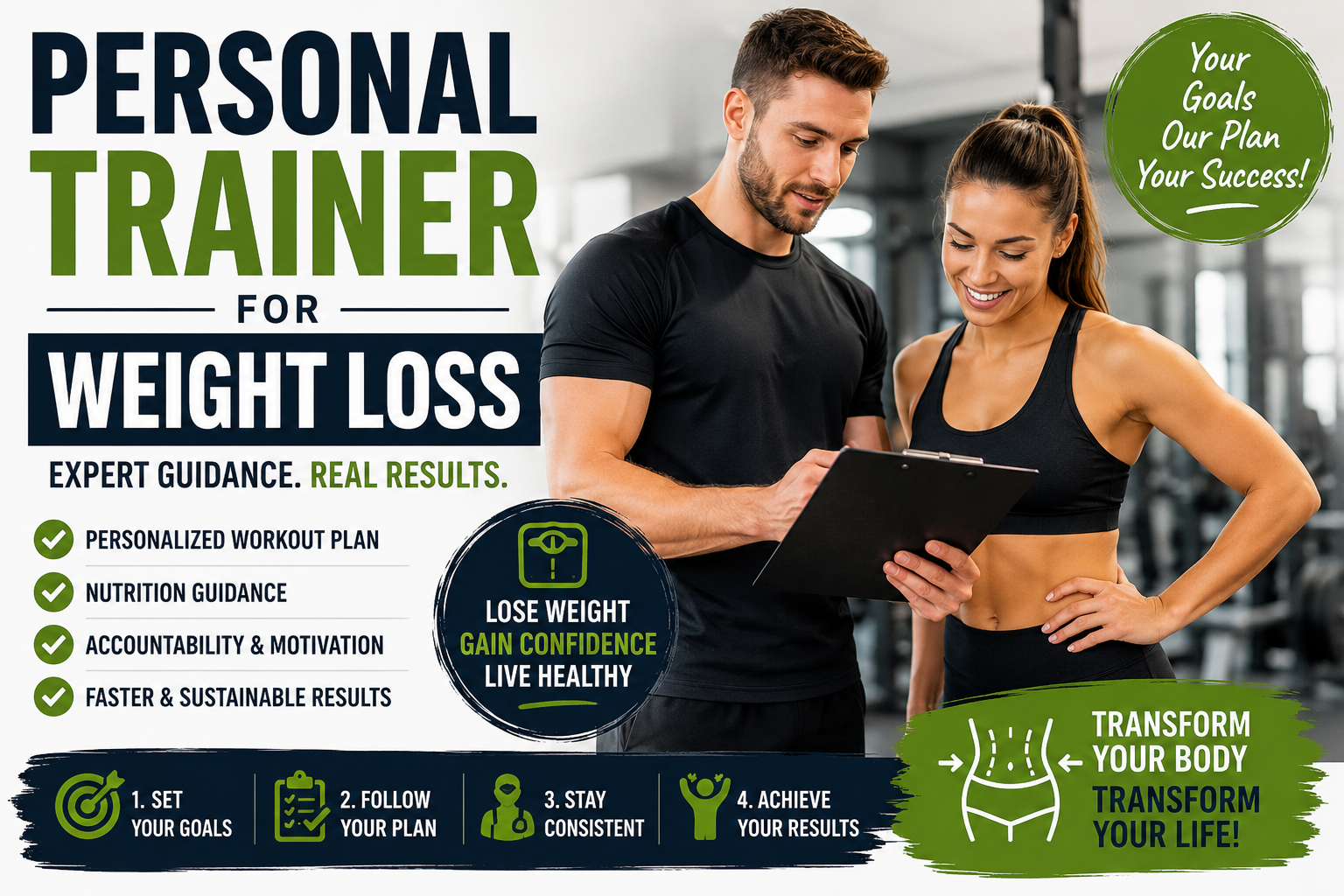
If you are trying to lose weight but struggling to stay consistent with exercise, nutrition, or your routine, you may be wondering whether hiring a personal trainer for weight loss is worth the money.
A personal trainer cannot magically burn fat for you, and no trainer can guarantee a specific amount of weight loss. However, a good trainer can provide something that many people struggle to create on their own: structure, accountability, individualized exercise programming, progression, and support.
Weight loss generally involves more than simply exercising harder. Physical activity is an important part of weight management, but calorie intake and overall lifestyle also matter. U.S. physical-activity guidance notes that combining calorie reduction with physical activity is generally more beneficial for weight loss than relying on either approach alone.
A qualified personal trainer can therefore be particularly useful when exercise is only one part of a broader weight-management strategy.
This guide explains what a personal trainer for weight loss does, how much help you can expect, what workouts may be included, how to choose the right trainer, questions to ask before hiring one, common mistakes to avoid, and whether personal training is worth the cost.
What Is a Personal Trainer for Weight Loss?
A personal trainer for weight loss is a fitness professional who designs and supervises exercise programs with the goal of helping a client improve fitness and, when appropriate, support weight-management goals.
A trainer may help with:
- Cardiovascular exercise
- Strength training
- Resistance training
- Mobility
- Exercise technique
- Workout progression
- Fitness assessments
- Accountability
- Exercise scheduling
- Habit formation
- General lifestyle guidance within the trainer’s professional scope
A qualified trainer should not simply give every client the same workout.
The American College of Sports Medicine’s certified personal trainer standards emphasize reviewing a client’s goals, medical history, exercise history, and assessment results before selecting and progressing exercise.
That individualized approach is one of the biggest advantages of personal training.
Can a Personal Trainer Help You Lose Weight?
Yes, a personal trainer can support weight loss, but the trainer does not independently cause fat loss.
Your results will depend on many factors, including:
- Food intake
- Physical activity
- Exercise consistency
- Sleep
- Stress
- Genetics
- Starting fitness level
- Medical conditions
- Medications
- Adherence to the program
A trainer’s biggest contribution may be helping you consistently perform the behaviors that support your goal.
For someone who knows what exercises to do but never follows through, accountability can be extremely valuable.
For someone who exercises regularly but has no idea how to progress, individualized programming may make a major difference.
For someone who is new to the gym, a trainer can also reduce uncertainty and teach proper exercise technique.
How Does a Personal Trainer Help With Weight Loss?
There are several ways a good trainer can support your journey.
1. Creates a Structured Workout Plan
One of the biggest problems people face is simply not knowing what to do.
You may walk into a gym and see:
- Treadmills
- Bikes
- Dumbbells
- Barbells
- Machines
- Cable systems
- Resistance bands
Without a plan, you might spend 20 minutes on one machine, perform random exercises, and leave without knowing whether the workout actually supported your goals.
A trainer can organize your sessions.
For example, a weekly plan might include:
Monday: Full-body strength training
Tuesday: Walking or cardio
Wednesday: Rest or light activity
Thursday: Full-body strength training
Friday: Cardio
Saturday: Optional activity
Sunday: Rest
The exact schedule should depend on the individual.
2. Provides Accountability
Accountability is one of the most practical reasons people hire personal trainers.
When you exercise alone, it is easy to say:
“I’ll go tomorrow.”
With a scheduled training session, you have a specific appointment.
A trainer can also monitor:
- Attendance
- Exercise performance
- Weight trends
- Measurements
- Strength improvements
- Cardiovascular fitness
- Workout consistency
This does not guarantee weight loss, but it can make adherence easier.
3. Helps You Progress Safely
Doing the same workout indefinitely may not provide the same challenge as your fitness improves.
A trainer can gradually adjust:
- Weight
- Repetitions
- Sets
- Exercise selection
- Rest periods
- Workout duration
- Intensity
This is known as progression.
ACSM’s personal-trainer standards emphasize selecting exercise based on goals, training experience, functional capacity, and progression principles.
Why Strength Training Matters During Weight Loss
Some people think weight loss means doing endless cardio.
That is not necessarily the best strategy.
Strength training can help preserve lean muscle while someone loses weight.
The CDC’s physical-activity guidance notes that muscle-strengthening activity can help maintain lean body mass during weight loss.
A trainer may therefore include exercises such as:
- Squats
- Lunges
- Step-ups
- Rows
- Chest presses
- Shoulder presses
- Hip hinges
- Deadlift variations
- Resistance-band exercises
- Core exercises
The specific exercises should be selected based on your abilities and limitations.
Can a Personal Trainer Help You Lose Belly Fat?
A trainer can help you reduce overall body fat, but they cannot guarantee that fat will disappear from your stomach first.
This is important because many people search for a trainer specifically to “lose belly fat.”
Exercises such as:
- Planks
- Crunches
- Leg raises
- Dead bugs
can strengthen abdominal muscles.
However, strengthening your abs does not mean you can selectively burn the fat covering them.
Overall fat loss depends on the broader energy balance and lifestyle.
A good trainer should explain this rather than promising a “flat stomach in two weeks.”
What Does a Weight-Loss Personal Training Session Look Like?
A typical session may last around 45–60 minutes, although session length varies.
A session could include:
Warm-Up
The trainer may begin with light movement, mobility exercises, or a gradual cardiovascular warm-up.
Strength Training
You may perform several resistance exercises targeting major muscle groups.
Cardiovascular Work
Depending on your goals and fitness level, the session may include:
- Walking
- Cycling
- Rowing
- Jogging
- Intervals
- Circuit training
Core or Mobility Work
The trainer may include exercises for stability, balance, or mobility.
Cool-Down
Some sessions end with lower-intensity movement or stretching.
The program should evolve as your fitness changes.
Personal Trainer Weight-Loss Workout Example
A beginner-friendly full-body session might look like:
Warm-Up
5–10 minutes of comfortable walking or cycling.
Exercise 1: Squat
2–3 sets of an appropriate number of repetitions.
Exercise 2: Row
2–3 sets.
Exercise 3: Chest Press
2–3 sets.
Exercise 4: Hip-Hinge Exercise
2–3 sets.
Exercise 5: Step-Up
2–3 sets.
Exercise 6: Core Exercise
2–3 sets.
Cardio
10–20 minutes of moderate activity depending on fitness.
This is only an example—not a personalized prescription.
A qualified trainer should adjust the exercises according to your:
- Age
- Fitness level
- Training history
- Goals
- Injuries
- Medical history
- Available equipment
How Much Exercise Do You Need for Weight Loss?
There is no single amount of exercise that guarantees weight loss.
The U.S. Physical Activity Guidelines indicate that adults should generally accumulate at least 150 minutes of moderate-intensity aerobic activity per week or an equivalent amount of vigorous activity, along with muscle-strengthening activity. People trying to lose a substantial amount of weight or maintain significant weight loss may need more activity, depending on their circumstances.
A personal trainer can help you gradually build toward an appropriate activity level.
For someone currently doing almost no exercise, immediately attempting extremely long workouts every day may be unrealistic.
A better strategy is often:
Start → adapt → progress → maintain.
Personal Trainer vs. Working Out Alone
Both approaches can work.
Working Out Alone
Advantages:
- Free or inexpensive
- Flexible schedule
- No appointment required
- Can be done at home
Disadvantages:
- Less accountability
- You must create your own program
- Technique may be uncertain
- Progression can be confusing
- Easier to skip workouts
Personal Trainer
Advantages:
- Individualized plan
- Scheduled sessions
- Exercise instruction
- Accountability
- Progress tracking
- Program adjustments
Disadvantages:
- Costs more
- Scheduling can be inconvenient
- Quality varies between trainers
- A trainer cannot guarantee results
The right choice depends on your needs and budget.
How Much Does a Personal Trainer Cost?
There is no universal price.
Costs vary significantly depending on:
- Country
- City
- Gym
- Trainer qualifications
- Experience
- Session length
- Training format
- Online vs. in-person coaching
- One-on-one vs. group training
A trainer in a major U.S. city may charge very differently from a trainer in a smaller city or another country.
Instead of asking only:
“How cheap is this trainer?”
consider:
“What am I actually getting for the price?”
A lower-priced trainer with poor programming may provide less value than a more experienced trainer who teaches you skills you can eventually use independently.
Online Personal Trainer for Weight Loss
You do not necessarily need face-to-face training.
An online trainer may provide:
- Workout plans
- Video demonstrations
- Weekly check-ins
- Messaging
- Progress tracking
- General nutrition guidance
- Exercise modifications
Online training can be less expensive and more flexible.
However, one disadvantage is that the trainer may not be physically present to observe your technique.
For beginners learning complex exercises, in-person instruction may be especially useful.
Personal Trainer at Home
Home personal training can be convenient for people who dislike gyms.
A trainer may bring:
- Resistance bands
- Dumbbells
- Portable equipment
or use equipment you already have.
Home training can also be useful for people who have limited gym access.
However, the quality of training depends on the trainer and available equipment.
How to Find the Best Personal Trainer for Weight Loss
Choosing a trainer is an important decision.
ACSM recommends treating the selection process seriously and asking questions before hiring a trainer.
Look for Appropriate Credentials
Ask about:
- Certification
- CPR/AED training
- Experience
- Continuing education
- Insurance, where applicable
For example, ACSM’s Certified Personal Trainer credential requires candidates to meet specified qualifications, including being at least 18 years old, having a high school diploma or equivalent, and holding adult CPR/AED certification.
Certification requirements vary between organizations and countries, so verify the specific credential rather than assuming every “certified trainer” has the same education.
Questions to Ask a Personal Trainer
Before hiring someone, ask:
“What certification do you have?”
A legitimate professional should be comfortable answering.
“Have you worked with people whose goal is weight loss?”
Experience can be useful, especially if you have specific challenges.
“How do you design my program?”
A good answer should involve your goals, history, fitness level, and limitations rather than simply giving you a generic routine.
“How do you measure progress?”
Progress can include:
- Strength
- Fitness
- Workout consistency
- Waist measurements
- Body weight
- Movement quality
Weight should not necessarily be the only metric.
“Do you provide nutrition advice?”
Ask what that means.
A trainer can often provide general healthy-lifestyle guidance within their scope, but individualized medical nutrition therapy may require a qualified dietitian or other appropriate professional.
ACSM’s standards emphasize the importance of working within a trainer’s scope of practice and collaborating with healthcare professionals when appropriate.
Personal Trainer and Nutrition
Nutrition is extremely important for weight loss.
Exercise alone may not compensate for consistently consuming more calories than your body needs.
The CDC’s physical-activity guidance specifically notes that both caloric intake and physical activity need to be considered for weight management, and that combining calorie restriction with physical activity tends to be most beneficial for weight loss.
A trainer can help you develop exercise habits, but you should be cautious about trainers who claim to treat medical conditions or prescribe highly restrictive diets without appropriate qualifications.
A registered dietitian or other qualified nutrition professional may be more appropriate for individualized nutrition therapy.
What Should You Eat While Working With a Personal Trainer?
There is no single weight-loss diet that works for everyone.
A generally balanced pattern can include:
- Vegetables
- Fruits
- Lean proteins
- Beans
- Lentils
- Whole grains
- Nuts
- Seeds
- Healthy fats
You can also include foods you enjoy.
The goal is not necessarily to eat perfectly.
The goal is to create a pattern you can maintain.
Protein
Protein-rich foods can help support muscle maintenance during weight loss.
Examples include:
- Eggs
- Chicken
- Fish
- Greek yogurt
- Cottage cheese
- Beans
- Lentils
- Tofu
Fiber
Fiber-rich foods include:
- Vegetables
- Fruits
- Beans
- Lentils
- Oats
- Whole grains
- Chia seeds
- Flaxseeds
Hydration
Adequate fluid intake is important, especially when physical activity increases.
Can a Personal Trainer Make a Meal Plan?
This depends on the trainer’s qualifications and local scope-of-practice rules.
A trainer may provide general healthy-eating education, but that does not necessarily make them qualified to provide individualized medical nutrition therapy.
Be especially cautious if a trainer:
- Diagnoses nutrient deficiencies
- Prescribes supplements for medical conditions
- Treats diabetes through diet without appropriate credentials
- Tells you to eliminate major food groups without a valid reason
- Prescribes extremely low-calorie diets
- Promises rapid weight loss
A good professional knows when to refer a client to another healthcare professional.
Personal Trainer for Women’s Weight Loss
Women may have different goals and considerations depending on age, training experience, pregnancy status, menopause, and other factors.
A trainer may help with:
- Strength training
- Cardiovascular fitness
- Muscle preservation
- Mobility
- General conditioning
However, pregnancy, postpartum recovery, menopause-related concerns, or medical conditions may require additional expertise and collaboration with healthcare professionals.
Personal Trainer for Men’s Weight Loss
Men may also have different goals, such as:
- Reducing body fat
- Preserving muscle
- Improving strength
- Improving cardiovascular fitness
- Preparing for sports
A trainer should build the program around the individual’s goals rather than assuming every man wants the same type of physique.
Personal Trainer for Beginners
Beginners may benefit especially from professional instruction.
A trainer can teach:
- How to adjust machines
- Proper lifting technique
- How to warm up
- How hard to exercise
- How to progress
- How to recover
- How to avoid common technique mistakes
This can make the gym feel much less intimidating.
Personal Trainer for People With Obesity
People with obesity can benefit from physical activity, but exercise programs may need to be modified according to fitness, mobility, health conditions, and exercise tolerance.
A trainer should not shame a client or force extremely intense workouts simply because weight loss is the goal.
The focus should be on sustainable progress.
For people with relevant cardiovascular, metabolic, or kidney disease—or concerning symptoms—medical clearance may be appropriate before beginning or intensifying exercise. ACSM’s consumer guidance recommends medical clearance in specified circumstances and emphasizes starting appropriately and progressing gradually.
Can Personal Training Help You Keep Weight Off?
Weight maintenance is often more difficult than losing weight initially.
A trainer may help by creating sustainable habits rather than relying on short-term challenges.
Useful long-term habits can include:
- Regular strength training
- Regular walking
- Consistent meal planning
- Monitoring progress
- Maintaining activity during busy periods
- Adjusting workouts as fitness changes
The CDC has reported that successful weight-loss maintainers commonly reported behaviors such as regular physical activity and planning meals.
How Long Should You Work With a Personal Trainer?
There is no required duration.
Some people benefit from:
4–8 weeks
to learn the basics.
Others prefer:
3–6 months
to establish a routine.
Some continue for years.
You do not necessarily need to pay for personal training forever.
One effective strategy is to use a trainer to learn:
- Exercise technique
- Program design
- Progression
- Basic fitness principles
- How to monitor your own progress
Then you may eventually transition to independent workouts.
Is One Personal Training Session Per Week Enough?
One session per week can still be useful.
For example, the trainer could teach you a strength program that you complete independently on other days.
A schedule might be:
Monday: Trainer session
Wednesday: Independent workout
Friday: Independent workout
Weekend: Walking or recreational activity
This can be more affordable than hiring a trainer for every workout.
Is Two or Three Sessions Per Week Better?
More sessions may provide more supervision, but more is not automatically better.
The best frequency is one you can:
- Afford
- Schedule
- Recover from
- Maintain consistently
A good trainer should not automatically sell you the most expensive package.
Personal Training and Cardio
Cardio can be useful for increasing physical activity and improving cardiovascular fitness.
Common options include:
- Walking
- Jogging
- Cycling
- Swimming
- Rowing
- Stair climbing
- Elliptical training
A trainer can help determine appropriate intensity.
Beginners may start with walking and gradually progress.
More advanced clients may use intervals or higher-intensity training when appropriate.
ACSM’s personal-trainer standards recognize multiple cardiovascular training methods and emphasize selecting them according to the client’s goals, experience, fitness level, and health considerations.
Personal Training and Resistance Training
Resistance training is another important component.
A trainer may use:
- Machines
- Free weights
- Dumbbells
- Barbells
- Resistance bands
- Bodyweight exercises
The exact equipment does not matter as much as using an appropriate program consistently.
In 2026, ACSM published an updated resistance-training position stand based on a review involving more than 30,000 participants. One of its key messages was that consistency matters more than unnecessarily complicated programs.
That is useful for weight-loss clients: you do not need an elaborate “secret” workout to make progress.
What a Good Weight-Loss Trainer Should NOT Promise
Be cautious if a trainer promises:
- “Lose 20 pounds in two weeks.”
- “Burn belly fat with these five exercises.”
- “This workout melts fat overnight.”
- “You don’t need to change your diet.”
- “My supplement will guarantee weight loss.”
- “Everyone gets the same results.”
- “You must train twice a day.”
Weight loss varies substantially between individuals.
A responsible trainer should discuss realistic expectations and focus on sustainable behavior.
Red Flags When Choosing a Personal Trainer
Avoid trainers who:
- Refuse to discuss credentials
- Ignore your medical history
- Force exercise despite pain
- Use humiliating language
- Guarantee specific weight-loss results
- Sell unnecessary supplements
- Prescribe extreme diets
- Claim to cure medical conditions
- Do not modify exercises when necessary
- Never track progress
- Give every client exactly the same program
A professional should recognize the limits of their role.
What Should Your First Session Include?
A quality first session may include:
Goal Discussion
What are you trying to achieve?
Health Screening
Relevant medical history and exercise considerations should be discussed.
Exercise History
The trainer should understand what you have previously done.
Fitness Assessment
Depending on the trainer’s qualifications and setting, this may include basic assessments of:
- Movement
- Strength
- Cardiovascular fitness
- Flexibility
- Balance
Program Discussion
You should understand how the trainer intends to approach your goal.
ACSM’s training standards specifically emphasize reviewing goals, medical history, exercise history, and assessment information before developing exercise programming.
How to Track Weight-Loss Progress With a Personal Trainer
The scale is only one measurement.
A trainer may also track:
- Waist circumference
- Body measurements
- Strength
- Number of repetitions
- Walking distance
- Cardio endurance
- Workout attendance
- Energy levels
- Movement quality
For example, if your weight remains stable while your waist decreases and your strength improves, that may represent meaningful progress.
What If the Scale Stops Moving?
Weight loss is rarely perfectly linear.
A temporary plateau can happen because of:
- Changes in water retention
- Reduced calorie deficit
- Changes in activity
- Increased muscle
- Inconsistent food intake
- Changes in routine
A trainer can help review your exercise program, but major dietary or medical adjustments may require other professionals.
How a Trainer Can Help You Build Habits
The most valuable thing a trainer may teach you is not a specific exercise.
It may be consistency.
For example, instead of saying:
“I need to work out for two hours every day.”
a trainer might help you establish:
30–60 minutes of planned activity several times per week.
Then that behavior becomes normal.
Over time, consistency can be more valuable than occasional extreme workouts.
Is a Personal Trainer Worth It for Weight Loss?
For some people, absolutely.
For others, no.
A personal trainer may be worth the investment if:
- You struggle with motivation
- You don’t know how to use gym equipment
- You need accountability
- You want individualized programming
- You have a history of stopping and restarting
- You want to learn strength training
- You need help progressing safely
A trainer may not be necessary if:
- You already exercise consistently
- You understand basic programming
- You enjoy working out alone
- Your budget is limited
- You can follow a reliable plan independently
You can lose weight without a personal trainer.
But a good trainer can make the process more structured and potentially easier to maintain.
How to Get the Most Value From Your Trainer
If you decide to hire one, maximize the investment.
Be Honest
Tell the trainer about:
- Your current activity
- Your eating habits
- Previous injuries
- Medical concerns
- Your schedule
- Your actual goals
Attend Consistently
Missing sessions reduces the value of the program.
Ask Questions
Learn why you’re doing each exercise.
Complete Independent Workouts
If your trainer gives you homework, follow it.
Track Your Progress
Record:
- Workouts
- Steps
- Strength
- Weight trends
- Measurements
Don’t Expect Magic
The trainer provides guidance.
You still have to perform the behaviors.
Can a Personal Trainer Help With Weight Loss Without a Gym?
Yes.
A trainer can create programs using:
- Bodyweight
- Resistance bands
- Dumbbells
- Walking
- Stairs
- Home cardio equipment
You do not need an expensive gym membership to become more physically active.
The best program is often the one you can perform consistently.
Personal Trainer vs. Weight-Loss Coach
These roles can overlap, but they are not necessarily identical.
A personal trainer generally focuses heavily on:
- Exercise
- Fitness
- Strength
- Cardiovascular training
- Movement
A weight-loss coach may focus more on:
- Habits
- Accountability
- Nutrition behaviors
- Goal setting
- Lifestyle changes
Some professionals combine both roles.
Always check their qualifications and scope of practice.
Personal Trainer vs. Dietitian
These professionals have different roles.
A personal trainer specializes primarily in exercise and fitness.
A registered dietitian or similarly qualified nutrition professional specializes in nutrition care.
For someone with complex nutritional needs, combining professional support may be more appropriate than expecting one trainer to handle everything.
Can a Personal Trainer Recommend Supplements?
Some trainers sell supplements.
That does not mean you need them.
Be skeptical of anyone who claims a supplement is necessary for weight loss or guarantees dramatic results.
A well-designed exercise and nutrition routine is far more important than most weight-loss supplements.
If you have questions about supplements, especially if you take medication or have a medical condition, consult an appropriate healthcare professional.
A Sample 12-Week Personal Trainer Weight-Loss Plan
A trainer should personalize a program, but a broad example could look like this:
Weeks 1–4: Build the Foundation
Focus on:
- Learning exercise technique
- Establishing a routine
- Walking regularly
- Two strength sessions per week
- Moderate cardio
- Basic nutrition habits
The goal is consistency rather than exhaustion.
Weeks 5–8: Increase Training
Gradually introduce:
- More resistance
- Additional repetitions
- Longer walks
- Additional cardio
- More challenging movements
The trainer monitors recovery.
Weeks 9–12: Improve Fitness
Depending on progress, the program may include:
- Progressive resistance training
- Longer aerobic sessions
- Intervals
- More advanced exercises
- Increased daily activity
The exact progression should depend on individual fitness and health.
What Results Can You Expect?
Do not judge a trainer based on promises of a specific number of pounds.
Results vary.
A person may lose weight quickly at first because of changes in water and food intake, while another person may see slower but sustainable progress.
Your trainer should focus on:
- Consistency
- Fitness
- Strength
- Healthy habits
- Sustainable weight management
Rather than promising a particular number on the scale.
The Role of Calories in Weight Loss
Exercise is valuable, but calorie intake remains important.
If you exercise for an hour and then consistently consume substantially more calories than your body uses, weight loss may not occur.
This is why successful programs often combine:
Nutrition + physical activity + behavior change.
CDC guidance similarly emphasizes considering both caloric intake and physical activity for weight control.
Can Walking With a Personal Trainer Help You Lose Weight?
Absolutely.
Walking is often underestimated.
A trainer could help you gradually increase:
- Daily steps
- Walking duration
- Walking frequency
- Pace
- Incline
For a beginner, a walking-based program may be much more sustainable than immediately starting intense running.
Personal Trainer for Weight Loss at Any Age
Exercise needs can change with age.
Older adults may benefit from programs emphasizing:
- Strength
- Balance
- Mobility
- Cardiovascular fitness
- Functional movement
The trainer should adjust exercises according to ability and medical considerations.
Likewise, younger adults may be able to tolerate different training volumes, but that does not mean more exercise is always better.
When Should You Talk to a Doctor Before Hiring a Trainer?
A personal trainer is not a substitute for medical evaluation.
Medical guidance may be especially important if you have:
- Known cardiovascular disease
- Metabolic disease
- Kidney disease
- Significant symptoms during exercise
- Serious injuries
- Other conditions that could affect exercise safety
ACSM’s guidance recommends medical clearance in relevant circumstances and emphasizes gradually progressing exercise when appropriate.
Final Verdict: Is a Personal Trainer Good for Weight Loss?
A personal trainer can be an excellent tool for weight loss, but the trainer is not a magic solution.
The greatest benefits may come from:
- Accountability
- Personalized exercise programming
- Proper technique
- Progressive training
- Consistency
- Motivation
- Progress tracking
The best trainer will not simply make you exhausted.
They will help you build a program you can actually maintain.
A strong weight-loss program usually combines regular physical activity with appropriate nutrition and sustainable lifestyle habits. Scientific guidance supports combining calorie management with physical activity, while resistance training can help maintain lean body mass during weight loss.
If you decide to hire a trainer, look for someone with appropriate credentials, relevant experience, good communication skills, and a willingness to work within their professional scope. ACSM specifically emphasizes client screening, individualized programming, progression, and collaboration with healthcare professionals when appropriate.
Most importantly, avoid anyone who promises instant results.
The best personal trainer for weight loss is not the person who promises the fastest transformation. It is the person who helps you develop a realistic, progressive, and sustainable fitness routine that you can continue long after the initial weight-loss goal is reached.
Frequently Asked Questions
How often should I see a personal trainer for weight loss?
There is no universal schedule. One session per week can be useful for accountability and program guidance, while two or three sessions can provide more direct supervision. The best frequency depends on your budget, schedule, goals, and ability to exercise independently.
Is a personal trainer better than going to the gym alone?
Not necessarily. A trainer can provide personalized programming and accountability, while someone who already understands exercise may be perfectly capable of training independently.
Can a personal trainer help me lose 20 pounds?
A trainer can help you establish exercise habits that support weight loss, but no responsible trainer can guarantee that you will lose a specific amount of weight. Results depend on many factors.
Can a personal trainer create a diet plan?
That depends on the trainer’s qualifications and local scope of practice. Trainers can often provide general healthy-lifestyle education, but individualized medical nutrition advice may require a qualified nutrition professional.
What is the best workout for weight loss?
There is no single best workout. A combination of aerobic activity and resistance training is a strong foundation, with the exact exercises adjusted to your fitness level and preferences.
Do I need cardio to lose weight?
Cardio can contribute to energy expenditure and cardiovascular health, but resistance training and overall daily activity are also important. A well-rounded program is usually preferable to relying on one type of exercise.
Can strength training help with weight loss?
Yes. Strength training can support weight management and help preserve lean body mass during weight loss.
Can a trainer help me lose belly fat?
A trainer can help you reduce overall body fat through a structured exercise program, but no trainer can guarantee that you will lose fat from your abdomen first.
Is online personal training effective?
It can be useful, particularly for people who want flexibility and lower costs. However, beginners may benefit from some in-person instruction to learn exercise technique.
How long does it take to see results?
It varies considerably. Fitness improvements can occur before major changes appear on the scale. Consistency over months is generally more useful than expecting dramatic changes within a few weeks.
Read More:
Where to Apply Progesterone Cream for Weight Loss
Is Beef Jerky Good for Weight Loss?
Benefits of Almond Milk for Females
Benefits of Dates, Milk, Walnut & Almond Smoothie
Health Benefits of Almond Milk




Leave a Reply