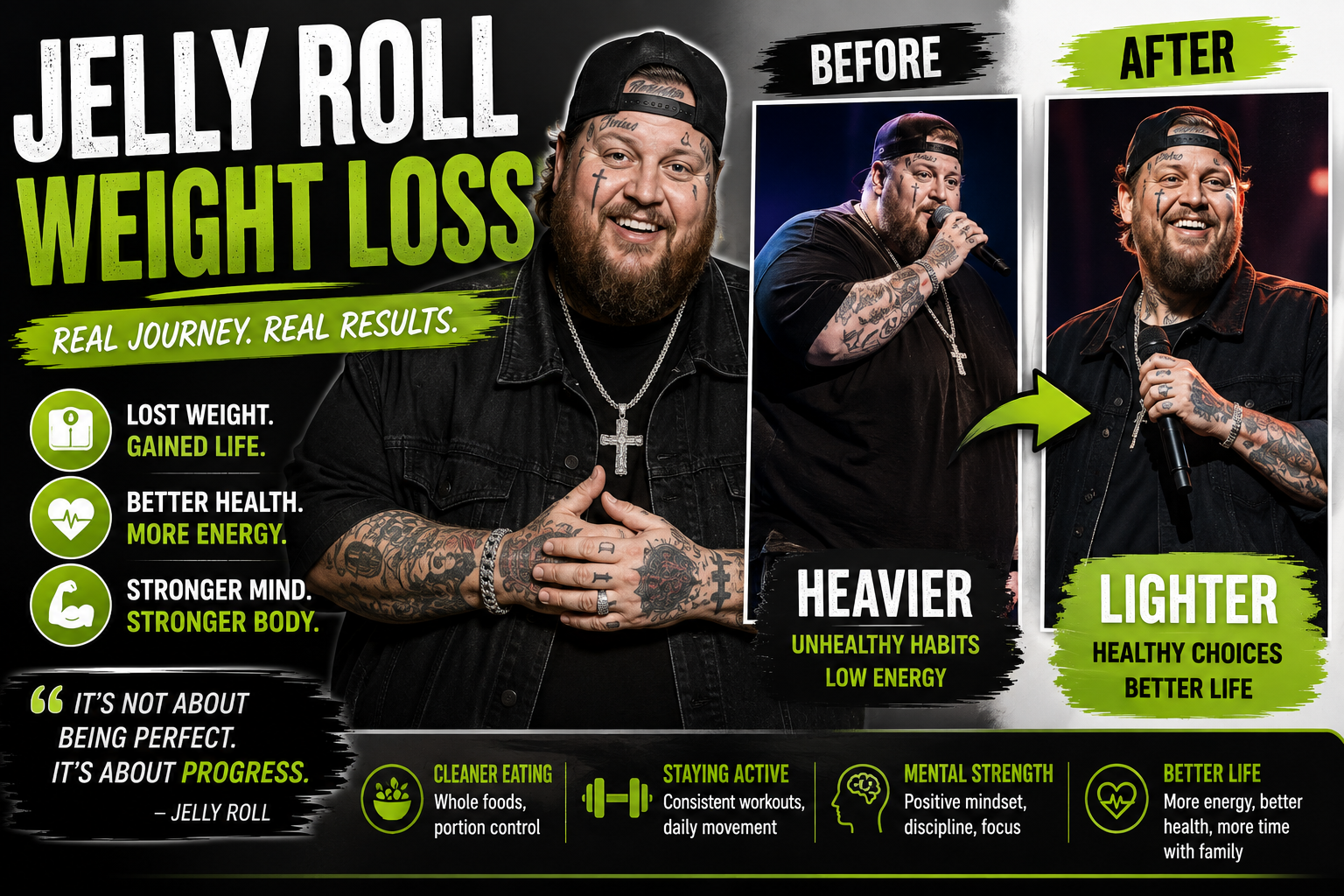
Jelly Roll’s weight loss journey has become one of the most talked-about celebrity transformations in recent years. The country-rap star, whose real name is Jason DeFord, has openly discussed his struggles with weight, food, addiction, mental health, and self-image.
At his heaviest, Jelly Roll has said he was around 540 pounds. By late 2025, he had reached approximately 265 pounds, representing a reported loss of about 275 pounds.
But his transformation wasn’t simply about going on a diet.
Jelly Roll has described his journey as a long-term effort to change his relationship with food, become more physically active, improve his health, and develop habits he could maintain. In January 2026, Men’s Health documented his transformation and highlighted how dramatically his fitness and mobility had changed.
And importantly, his story hasn’t been completely linear. In 2026, Jelly Roll has also spoken publicly about stress eating and struggles with overeating, showing that maintaining weight loss can be just as challenging as achieving it.
How Much Weight Did Jelly Roll Lose?
According to his interviews and Men’s Health coverage, Jelly Roll went from an estimated 540 pounds at his highest weight to approximately 265 pounds, meaning he lost around 275 pounds.
The numbers weren’t necessarily measured from one perfectly documented starting point. Jelly Roll has explained that the scale he initially used maxed out around 520 pounds, so his highest weight may have been somewhat different from the 540-pound estimate he later gave.
His transformation therefore represents hundreds of pounds of weight loss over several years, rather than a quick before-and-after diet.
That distinction matters.
Social media often makes weight loss appear to happen overnight. Jelly Roll’s story shows something different: major physical changes can take years of repeated effort, setbacks, adjustments, and consistency.
Jelly Roll’s Weight Loss Journey Didn’t Start With Exercise
One of the most interesting parts of Jelly Roll’s story is that his first major step wasn’t simply joining a gym.
He realized that his relationship with food needed attention.
In his Men’s Health interview, Jelly Roll explained that he began looking at overeating differently and eventually started treating food as something connected to his addictive behavior. He also worked with a therapist to address the underlying issues surrounding overeating.
This became an important part of his transformation.
Instead of thinking only:
“How can I lose weight?”
his approach increasingly became:
“Why am I eating this way, and what needs to change?”
That distinction can be important for anyone who has repeatedly lost weight and then regained it.
Why Jelly Roll Wanted to Lose Weight
Jelly Roll has been unusually open about how his weight affected his everyday life.
At his highest weight, basic activities had become difficult. He described having trouble walking significant distances and dealing with everyday tasks that many people take for granted.
His motivation wasn’t simply about looking different.
He wanted to become healthier, move more easily, live longer, and be more present in his life.
He also set himself an ambitious public goal: appearing on the cover of Men’s Health.
That goal became a major source of accountability.
He had talked publicly about wanting to achieve the cover before eventually appearing on the January/February 2026 issue.
Jelly Roll’s Highest Weight
Jelly Roll has reported that his highest weight was approximately 540 pounds around 2020.
However, he has also acknowledged some uncertainty around the exact number because the scale he initially used couldn’t accurately measure weights above its maximum range.
At that point, he recognized that his health needed to change.
But instead of attempting an overnight transformation, his journey developed gradually.
That would become one of the most important lessons from his story.
The First Changes Were Small
Jelly Roll’s fitness journey eventually became extremely demanding, but he didn’t begin by running miles every morning.
According to reporting from EatingWell, one of his early fitness activities was simply walking to his mailbox. Over time, those small amounts of movement increased.
That progression is significant.
Someone who struggles to walk a mile doesn’t necessarily need to begin with an intense workout program.
A more realistic progression can be:
Very little movement → short walks → longer walks → regular exercise → higher-intensity training
Jelly Roll’s journey followed a similar progression.
From Walking to Running
As his fitness improved, Jelly Roll became increasingly active.
By 2025, he was reportedly walking and running several miles, with his routine including intervals of running and walking. Men’s Health documented him completing a four-mile session and described how dramatically his endurance had improved compared with the beginning of his journey.
This is one of the clearest examples of how gradual progress can compound.
At the beginning, walking to the mailbox was an accomplishment.
Later, he was running.
The goal wasn’t necessarily to become a runner immediately.
The goal was to become capable of doing more than he could do before.
Jelly Roll’s Approach to Food
Food became another major focus.
Rather than simply trying to eliminate every food he enjoyed, Jelly Roll worked on understanding why he was eating.
He has described his relationship with food in terms of addiction and emotional eating, and therapy became part of addressing those patterns.
He also worked with a broader wellness team to support his nutrition, movement, sleep, and stress management.
This is an important distinction for readers:
Jelly Roll’s weight loss wasn’t based on one magical food.
It was the result of multiple changes working together.
His Weight Loss Wasn’t Linear
It’s easy to look at a celebrity transformation and imagine a perfectly straight line downward.
Real life doesn’t work that way.
Jelly Roll has continued discussing challenges with food even after losing hundreds of pounds.
In July 2026, he spoke publicly about stress eating and overeating, comparing the struggle to other addictive behaviors.
That makes his story particularly relevant.
Losing weight doesn’t automatically mean that cravings, emotional eating, stress, or difficult periods disappear.
Sometimes the real challenge is learning how to respond when those problems return.
Jelly Roll’s Transformation Is About More Than a Number
Going from approximately 540 pounds to around 265 pounds is an extraordinary physical change.
But the most interesting part of the story may be what happened between those numbers.
He went from struggling with basic movement to running.
He went from avoiding his body to publicly documenting his transformation.
He went from setting a seemingly unrealistic goal of appearing on Men’s Health to actually becoming the magazine’s cover star.
And he continues to work on maintaining his progress rather than presenting himself as someone who has “finished” the journey.
His story demonstrates that major weight loss can involve behavioral change, physical activity, nutrition, emotional work, professional support, and persistence—not simply a restrictive diet.
What Readers Can Learn From Jelly Roll’s Story
The biggest lesson isn’t that everyone should copy Jelly Roll’s diet or workout.
Instead, his journey highlights several principles that can apply more broadly:
- Start where you are.
- Small improvements can lead to major changes.
- Weight loss isn’t always linear.
- Your relationship with food matters.
- Exercise can progress gradually.
- A meaningful goal can provide motivation.
- Long-term maintenance requires continued effort.
And perhaps most importantly, you don’t have to transform everything about your life overnight.
Jelly Roll himself has described previous attempts as failing when he tried to change everything at once. His later approach was much more methodical.
How Did Jelly Roll Lose Weight?
Jelly Roll’s transformation wasn’t based on a single diet, supplement, or workout.
Instead, his reported approach combined nutrition changes, regular physical activity, professional support, therapy, and a major shift in his relationship with food. His routine also evolved as his fitness improved.
That’s important because many people searching for “how did Jelly Roll lose weight?” are looking for one secret answer.
There doesn’t appear to be one.
His transformation was a process.
1. He Changed His Relationship With Food
One of the most significant aspects of Jelly Roll’s journey was addressing his relationship with food.
He has spoken openly about overeating and described food as something that could become addictive for him. Rather than treating the problem as simply a lack of willpower, he worked on the underlying behaviors and emotions contributing to overeating.
Therapy became part of this process.
This is an important lesson because calorie restriction alone doesn’t necessarily solve emotional eating.
Someone can know exactly how many calories are in a food and still eat it when they’re stressed, upset, bored, or overwhelmed.
Jelly Roll’s approach increasingly focused on understanding those triggers.
2. He Started With Walking
Today, Jelly Roll is associated with running and demanding workouts.
But he didn’t start there.
Early in his transformation, simply becoming more mobile was a major achievement.
Reports have described how his activity progressed from walking short distances to eventually walking and running several miles.
This is one of the most useful parts of his story for beginners.
You don’t need to be fit before starting exercise.
You become fitter by gradually doing more than your body is accustomed to.
For someone who currently gets very little activity, that could mean:
5-minute walk → 10-minute walk → 20-minute walk → longer walks → intervals → jogging
The exact progression should depend on the individual’s fitness and health.
3. He Progressed Into Running
As Jelly Roll became lighter and fitter, his exercise routine became more challenging.
His training eventually included walking and running intervals.
According to Men’s Health, he was able to complete several-mile sessions, something that would have been extremely difficult earlier in his journey.
The transformation therefore wasn’t simply:
“He lost weight, then started exercising.”
Exercise became part of the process that helped him become more capable.
That difference matters.
Fitness isn’t just about burning calories.
It’s also about improving:
- Endurance
- Strength
- Mobility
- Cardiovascular fitness
- Confidence
- Daily energy
4. He Set Fitness Goals
One of Jelly Roll’s strategies was turning weight loss into something bigger than a number on the scale.
He wanted to become capable of doing things that previously seemed impossible.
One notable example was his goal of completing a 5K.
Rather than simply saying, “I need to lose another 20 pounds,” a performance goal gives you something concrete to work toward.
You can measure:
- Distance
- Running time
- Walking time
- Strength
- Endurance
- Recovery
This can make fitness more motivating than watching the scale every day.
5. He Worked With Professionals
Jelly Roll’s transformation also involved professional support.
His reported wellness team included people involved with nutrition, fitness, therapy, and other aspects of his health.
This is particularly relevant given the scale of his transformation.
Losing hundreds of pounds isn’t comparable to following a generic seven-day diet plan from social media.
People with significant weight-management goals may benefit from professional guidance, particularly when there are medical conditions, medications, mobility limitations, or a history of disordered eating.
6. He Focused on Nutrition
Although the internet often searches for a specific “Jelly Roll diet,” his reported approach wasn’t simply one restrictive menu that everyone should copy.
Instead, nutrition was part of a broader lifestyle change.
His food choices were structured around helping him lose weight while supporting his increasingly active lifestyle.
The bigger principle is:
Eat in a way that supports your goal rather than relying on extreme restriction.
A weight-loss diet can include foods such as:
- Lean protein
- Eggs
- Fish
- Chicken
- Vegetables
- Fruit
- Beans
- Whole grains
- Yogurt
- Healthy fats
The exact calorie and macronutrient requirements vary from person to person.
7. He Increased His Physical Activity
Jelly Roll’s transformation illustrates how dramatically physical capacity can change.
At his highest weight, walking was difficult.
Later, he was participating in workouts and running.
That progression can be more meaningful than the scale itself.
Imagine being unable to comfortably walk a short distance and eventually being able to complete several miles.
That’s a major functional transformation.
For people beginning their own weight-loss journey, this provides an important reminder:
Fitness progress doesn’t have to start with intense workouts.
It can start with movement you can actually sustain.
8. He Used Accountability
Public goals can create accountability.
Jelly Roll frequently talked about his transformation publicly, which meant his progress wasn’t happening entirely behind closed doors.
His goal of appearing on Men’s Health became a particularly visible milestone.
Eventually, he achieved that goal when he appeared on the magazine’s January/February 2026 cover.
Having a meaningful goal can help people stay focused.
However, accountability doesn’t have to mean sharing your journey publicly.
It could simply mean:
- Tracking your workouts
- Recording your weight trend
- Working with a trainer
- Having a walking partner
- Preparing meals ahead of time
- Checking in with a dietitian
9. He Didn’t Treat a Setback as the End
This may be one of the most realistic aspects of Jelly Roll’s story.
Even after losing hundreds of pounds, he has continued to talk about struggles with food.
In 2026, he discussed stress eating and overeating, explaining that these behaviors could become difficult during stressful periods.
That’s important because weight loss isn’t a simple before-and-after photograph.
A person can lose weight and still experience:
- Cravings
- Emotional eating
- Stress
- Increased appetite
- Periods of overeating
- Motivation problems
The difference is learning how to respond when those situations occur.
10. He Worked on the Mental Side of Weight Loss
Weight loss is often discussed as if it’s purely mathematical:
Calories in < Calories out = Weight loss
Energy balance is fundamental, but human eating behavior is much more complicated.
Stress, emotions, habits, environment, sleep, social situations, and food availability can all influence what someone eats.
Jelly Roll’s openness about therapy and his relationship with food highlights this side of weight management.
For some people, improving eating habits may require more than a meal plan.
It may require working on the reasons behind the eating behavior.
Did Jelly Roll Have Weight-Loss Surgery?
This is one of the most frequently searched questions about his transformation.
Jelly Roll has publicly discussed his weight-loss journey and the different methods he has used, but readers should be careful with online claims that automatically attribute his transformation to surgery.
Celebrity weight-loss stories frequently produce speculation that isn’t supported by reliable evidence.
The safest approach is to distinguish between:
What Jelly Roll has publicly confirmed
and
What people online speculate about.
His publicly discussed transformation has involved nutrition, exercise, behavioral changes, and professional support.
Don’t present an unconfirmed medical procedure as a fact.
Did Jelly Roll Use Ozempic or Other Weight-Loss Drugs?
Another major question surrounding celebrity weight loss is whether prescription medications were involved.
Again, this is an area where online speculation can easily become misinformation.
Jelly Roll has discussed different aspects of his weight-loss journey publicly, but an article shouldn’t claim that he used a specific prescription weight-loss medication unless there is reliable evidence and a clear statement from him or his representatives.
This is particularly important because medications such as GLP-1 drugs are prescription treatments and aren’t appropriate for everyone.
A celebrity’s reported weight-loss journey shouldn’t be interpreted as a recommendation to use medication.
Jelly Roll’s Goal Wasn’t Simply to Become Thin
This distinction is easy to miss.
His transformation wasn’t only about making the number on the scale smaller.
He wanted to become healthier and more physically capable.
His fitness goals included activities that had previously been difficult or impossible.
That means his progress could be measured in several ways:
Weight
The most obvious measurement.
Fitness
How far he could walk or run.
Mobility
How easily he could move.
Strength
What his body could physically accomplish.
Mental Well-Being
His ability to handle stress and manage his relationship with food.
Lifestyle
The habits he could maintain over time.
This broader definition of success can be much healthier than focusing exclusively on body weight.
What Makes Jelly Roll’s Weight Loss Different?
Many celebrity weight-loss stories follow a familiar pattern:
Before → Diet → Dramatic Transformation → After
Jelly Roll’s story is more complicated.
It includes:
Severe obesity → Small changes → Walking → Nutrition → Therapy → Increased fitness → Running → Major weight loss → Maintenance challenges
That makes it more relatable.
His journey demonstrates that losing weight isn’t necessarily about finding the perfect diet.
It’s about repeatedly making better choices and adjusting when life becomes difficult.
5 Important Lessons From Jelly Roll’s Journey
Lesson 1: Start With What You Can Do
If running is impossible, walk.
If walking for 30 minutes is difficult, start with a few minutes.
The best exercise routine isn’t necessarily the hardest one.
It’s the one you can actually continue.
Lesson 2: Don’t Ignore Emotional Eating
If you repeatedly eat when stressed or upset, simply creating a stricter diet may not solve the problem.
Understanding your triggers can be just as important as understanding calories.
Professional support can be useful when emotional eating feels difficult to control.
Lesson 3: Build Fitness Gradually
Jelly Roll didn’t go from 540 pounds to running several miles overnight.
His physical activity developed over time.
That principle applies to almost every fitness journey.
Lesson 4: Don’t Expect a Perfect Journey
Weight can fluctuate.
Motivation can disappear.
Stress can increase.
Old eating habits can return.
A setback doesn’t erase months or years of progress.
Lesson 5: Find a Reason Bigger Than the Scale
A goal such as:
- Running a 5K
- Playing with your children
- Walking without getting exhausted
- Improving your health
- Feeling more comfortable moving
can sometimes provide more motivation than a specific number on the scale.
What You Shouldn’t Copy From Jelly Roll
Jelly Roll’s transformation can be inspiring, but you shouldn’t attempt to reproduce his exact routine.
His body, medical history, starting weight, lifestyle, genetics, resources, and professional support are different from yours.
Don’t assume that:
- His calorie intake is right for you
- His exercise routine is right for you
- His weight-loss rate is achievable for everyone
- His food choices are medically appropriate for everyone
- His results can be duplicated on the same timeline
The useful lesson isn’t “do exactly what Jelly Roll did.”
It’s:
Find a sustainable approach that works for your own body and circumstances.
What Happened After He Lost 275 Pounds?
Reaching approximately 265 pounds wasn’t necessarily the end of Jelly Roll’s journey.
In fact, maintaining major weight loss can introduce a different set of challenges.
Your body changes.
Your calorie requirements change.
Your lifestyle changes.
And the habits that helped you lose weight need to become habits you can maintain.
Jelly Roll’s more recent comments about stress eating demonstrate this reality.
The transformation therefore isn’t simply:
Lose 275 pounds → Finished
It’s:
Lose weight → Maintain progress → Continue working on habits → Adapt when circumstances change
That may ultimately be the more important part of his story.
The Biggest Takeaway From Jelly Roll’s Transformation
Jelly Roll’s weight loss is remarkable because of its scale, but the most useful lesson isn’t the number of pounds he lost.
It’s the process.
He started from a point where basic movement was difficult.
He gradually became more active.
He worked on nutrition.
He addressed his relationship with food.
He sought professional support.
He set fitness goals.
And he continued working through setbacks.
That’s a very different message from the typical “lose 30 pounds in 30 days” approach.
Real transformation can take years.
And for someone with a substantial amount of weight to lose, slow progress is still progress.
Jelly Roll Weight Loss Timeline
| Stage | Reported Development |
|---|---|
| Around 2020 | Highest reported weight around 540 lb |
| Early journey | Began focusing on movement and walking |
| Later progression | Increased walking and fitness training |
| 2024–2025 | Major weight-loss and fitness transformation became public |
| 2025 | Reported substantial additional weight loss and increased running |
| January 2026 | Reported weight around 265 lb |
| 2026 | Continued discussing maintenance, stress eating, and his relationship with food |
These figures are based on Jelly Roll’s public statements and media reporting and should be treated as approximate rather than precise medical records.
What Can You Learn From Jelly Roll’s Weight Loss?
Jelly Roll’s transformation is interesting not simply because he reportedly lost hundreds of pounds, but because his journey highlights many of the difficulties that come with long-term weight management.
Here are some of the most useful lessons readers can take away.
1. You Don’t Have to Change Everything on Day One
One of the biggest mistakes people make when starting a weight-loss journey is trying to completely transform their lifestyle overnight.
A person may suddenly decide to:
- Follow an extremely restrictive diet
- Exercise every day
- Stop eating all their favorite foods
- Track every calorie
- Wake up at 5 a.m.
- Completely eliminate carbohydrates
That approach can be difficult to maintain.
Jelly Roll’s story shows the potential value of progressive change. His physical activity developed over time rather than beginning with advanced workouts.
For someone starting from a low level of fitness, even a short walk can be a meaningful first step.
2. Your Starting Point Doesn’t Determine Your Final Destination
When Jelly Roll was at his highest reported weight, long-distance exercise wasn’t realistic.
Eventually, he became capable of running several miles.
That illustrates an important principle:
Your current fitness level is not necessarily your permanent fitness level.
Someone who currently struggles to walk for 10 minutes may eventually be able to walk for an hour.
Someone who can’t jog for one minute may eventually complete a 5K.
Progress comes from gradually increasing what your body can handle.
3. Weight Loss Is More Than Calories
Calories matter, but people aren’t calculators.
Food is connected to:
- Emotions
- Habits
- Stress
- Social situations
- Environment
- Sleep
- Personal preferences
Jelly Roll’s willingness to discuss his relationship with food is therefore one of the most valuable parts of his story.
If someone repeatedly overeats when stressed, simply telling them to “eat fewer calories” may not address the underlying problem.
That’s where behavioral strategies and professional support can become important.
4. Exercise Can Be About What Your Body Can Do
It’s easy to think about exercise only as a way to burn calories.
But Jelly Roll’s transformation demonstrates another benefit.
Exercise allowed him to become more capable.
Instead of asking:
“How many calories did I burn?”
you can sometimes ask:
“What can my body do now that it couldn’t do before?”
Maybe you can:
- Walk farther
- Climb stairs more easily
- Carry groceries
- Run for several minutes
- Lift heavier weights
- Play with your children
- Hike without stopping
These improvements can be motivating even when the scale isn’t moving quickly.
5. Weight-Loss Plateaus Don’t Mean Failure
Almost everyone who loses a significant amount of weight eventually experiences periods when progress slows.
This can happen because:
- Your body weighs less
- Your energy requirements decrease
- Your activity changes
- Your calorie intake gradually increases
- Water retention masks fat loss
- Your routine becomes less consistent
A plateau doesn’t automatically mean the plan has failed.
Instead, review the situation and make reasonable adjustments.
Did Jelly Roll Lose Weight Naturally?
The word “naturally” can mean different things.
If someone means without any effort or medical support, then no—Jelly Roll’s transformation involved substantial lifestyle changes and professional support.
If they mean through lifestyle changes rather than relying on a single quick-fix solution, his publicly described journey has heavily emphasized:
- Nutrition
- Exercise
- Walking and running
- Behavioral changes
- Therapy
- Professional support
Readers should avoid turning his experience into a claim that one particular method is responsible for all of his weight loss.
Did Jelly Roll Have Weight-Loss Surgery?
There has been online speculation about whether Jelly Roll underwent bariatric surgery.
However, speculation should not be presented as fact.
A responsible article should distinguish between confirmed information and internet rumors.
His publicly documented transformation has focused heavily on lifestyle changes, exercise, nutrition, and addressing his relationship with food.
Unless Jelly Roll himself or a reliable representative confirms a medical procedure, readers shouldn’t assume surgery was responsible for his transformation.
Did Jelly Roll Take Ozempic?
Another common search question is whether Jelly Roll used Ozempic or another GLP-1 medication.
Celebrity weight-loss discussions frequently generate speculation about these medications.
However, an article shouldn’t state that someone used a prescription medication without reliable confirmation.
Even if a celebrity uses a particular medication, that doesn’t mean it is appropriate for another person.
Prescription weight-management medications should be discussed with a qualified healthcare professional.
What Is Jelly Roll’s Weight Now?
Jelly Roll reported being around 265 pounds in early 2026, after previously reaching a much higher weight.
However, his weight should not be treated as a permanent number.
Body weight naturally fluctuates, and celebrities don’t necessarily publish their current weight continuously.
More importantly, his recent discussions suggest that his focus has shifted from simply losing weight toward maintaining progress and managing stress-related eating.
Jelly Roll’s Weight-Loss Goal
At various points, Jelly Roll has talked about continuing to improve his fitness and health rather than simply stopping once he reached a particular number.
His transformation shows that goals can evolve.
The first goal might be:
“I need to lose weight.”
Then it becomes:
“I want to walk farther.”
Then:
“I want to run.”
Then:
“I want to maintain my health.”
This progression can make long-term lifestyle change more sustainable.
10 Practical Weight-Loss Lessons Inspired by Jelly Roll
1. Start Small
You don’t need a perfect plan.
Start with one habit you can realistically maintain.
2. Walk More
Walking is accessible to many people and can be increased gradually.
3. Improve Your Food Environment
Keep nutritious foods readily available and make highly tempting foods less convenient.
4. Prioritize Protein
Protein-rich foods can help make meals more satisfying.
5. Eat More Fiber
Vegetables, fruit, beans, lentils, and whole grains can help create filling meals.
6. Don’t Chase Extreme Diets
A diet you can maintain for months is generally more useful than a crash diet that lasts one week.
7. Address Emotional Eating
If stress or emotions regularly trigger overeating, work on the underlying behavior instead of simply imposing stricter food rules.
8. Set Fitness Goals
Try goals such as walking a certain distance or completing a beginner workout program.
9. Expect Setbacks
A bad meal or difficult week doesn’t erase your progress.
10. Think Long Term
The ultimate goal isn’t simply losing weight.
It’s building habits you can continue after the weight comes off.
Jelly Roll Weight Loss FAQ
How much weight did Jelly Roll lose?
Jelly Roll has publicly reported losing approximately 275 pounds, going from around 540 pounds at his highest reported weight to approximately 265 pounds by early 2026.
How did Jelly Roll lose so much weight?
His publicly discussed approach included changes to nutrition, increased physical activity, walking and running, professional support, and working on his relationship with food and emotional eating.
What diet did Jelly Roll follow?
There isn’t a single universally confirmed “Jelly Roll diet” that readers should copy. His reported transformation involved broader changes to nutrition and lifestyle.
Did Jelly Roll exercise?
Yes. His fitness journey progressed from walking to more demanding activities, including running several miles.
Did Jelly Roll run a 5K?
Running became an important part of his fitness journey, and he publicly worked toward running longer distances as his fitness improved.
Did Jelly Roll have weight-loss surgery?
There has been online speculation, but unconfirmed speculation shouldn’t be presented as fact.
Did Jelly Roll use Ozempic?
There are online discussions about celebrity use of GLP-1 medications, but you shouldn’t assume that Jelly Roll used a particular prescription drug without reliable confirmation.
What was Jelly Roll’s highest weight?
He has reported his highest weight at approximately 540 pounds, although he has also explained that his earlier scale could not accurately measure weights above its maximum capacity.
What is Jelly Roll’s weight now?
He reported being around 265 pounds in early 2026. His current weight can change, so this shouldn’t be treated as a permanent figure.
Is Jelly Roll still trying to lose weight?
His recent discussions indicate that maintaining his progress and managing his relationship with food remain important parts of his journey.
Can I follow Jelly Roll’s diet?
You can take general inspiration from his commitment to healthier habits, but you shouldn’t copy a celebrity’s exact calorie intake or exercise routine. Your nutritional and exercise needs are individual.
The Real Story Behind Jelly Roll’s Transformation
Jelly Roll’s weight loss is often reduced to a dramatic number:
275 pounds lost.
But that number doesn’t tell the whole story.
Behind it were years of gradual changes.
There were walks before runs.
There were difficult periods before major milestones.
There were changes in eating habits.
There was therapy.
There was professional support.
And there were setbacks.
That’s what makes his story more useful than a simple celebrity before-and-after picture.
His transformation demonstrates that substantial weight loss can be a long-term process rather than a quick challenge.
Final Thoughts
Jelly Roll’s weight loss journey is one of the most dramatic celebrity transformations of recent years.
Going from an estimated 540 pounds to approximately 265 pounds represents a reported loss of roughly 275 pounds. But his story isn’t simply about losing weight.
It’s about becoming more physically capable, changing his relationship with food, addressing emotional triggers, becoming more active, and continuing to work on his health even after reaching major milestones.
Perhaps the biggest lesson is this:
You don’t need to become a completely different person tomorrow.
Start with what you can do today.
Walk a little more.
Make one better meal.
Drink more water.
Work on your relationship with food.
Get professional help when you need it.
Then repeat those improvements consistently.
Over time, small changes can become a completely different lifestyle.
Suggested Articles
- Weight Loss Calculator
- Best Foods for Weight Loss
- High Protein Snacks for Weight Loss
- Low-Calorie Healthy Snacks
- Healthy Snack Ideas
- Best Foods to Reduce Belly Fat




Leave a Reply