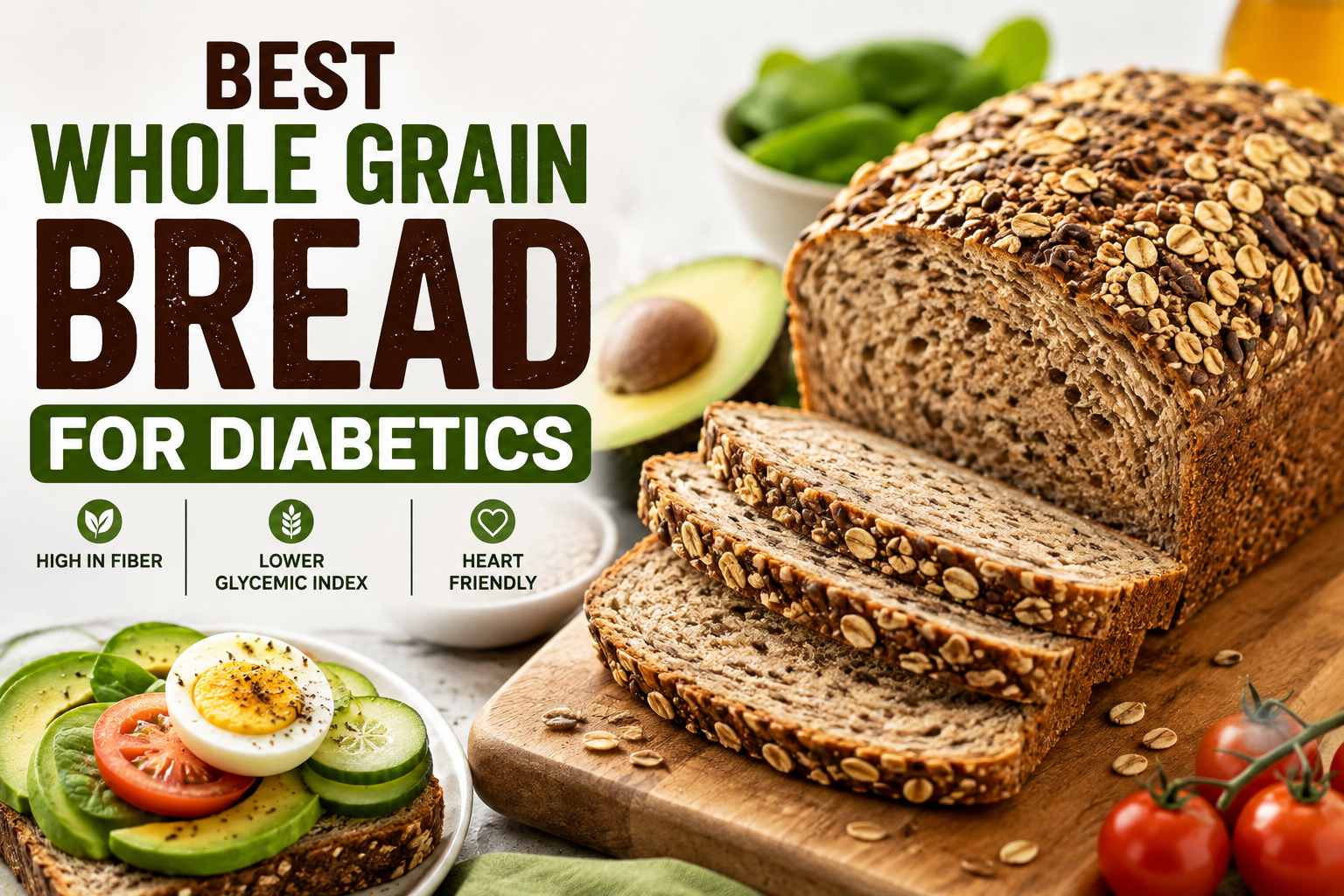
Carbohydrates are broken down into glucose, which can raise blood sugar levels. Bread is therefore not a “free food” for people with diabetes. The goal is usually to choose carbohydrate sources that provide more nutrition and fiber and to pay attention to portion size.
The CDC explains that refined grains such as white bread have much of their fiber removed during processing, while whole grains contain fiber and other nutrients and generally affect blood sugar more gradually.
That is why replacing white bread with a genuinely whole-grain option can be a useful change.
However, an important point needs to be emphasized:
Whole-grain bread is still a carbohydrate-containing food.
A person with diabetes may still need to consider the number of carbohydrate grams in each slice and the total amount eaten at a meal. For people who use mealtime insulin, carbohydrate counting can be particularly important for matching insulin to food intake.
What Is the Best Whole Grain Bread for Diabetics?
For most people, there is no single brand that is automatically the best. Instead, the best choice is usually a bread with the following characteristics:
- 100% whole grain or whole wheat as the main ingredient
- At least 3 grams of fiber per serving when possible
- Little or no added sugar
- A reasonable amount of carbohydrates per serving
- Moderate sodium
- Minimal highly refined ingredients
- A portion size that fits the person’s meal plan
The American Diabetes Association’s 2026 Standards of Care encourages people with diabetes to emphasize minimally processed, nutrient-dense, high-fiber carbohydrate sources and specifically identifies 100% whole-wheat bread as an example of a whole-grain food to encourage where culturally appropriate. Foods containing at least 3 grams of fiber per serving are generally considered higher-fiber choices.
My Top Choice: 100% Whole-Wheat Bread
For many people with diabetes, 100% whole-wheat bread is one of the simplest and most widely available choices.
The important words are “100% whole wheat.”
Do not assume that a package labeled only:
- Wheat bread
- Brown bread
- Multigrain bread
- Seven-grain bread
- Honey wheat bread
is automatically made mostly from whole grains.
The CDC specifically recommends checking the ingredient list and choosing products with whole wheat flour listed first, rather than enriched, unbleached, or simply multigrain flour.
A dark brown color also does not guarantee that a bread is whole grain. Some breads may use coloring or have seeds added to the outside while still relying heavily on refined flour.
1. 100% Whole-Wheat Bread
Why it can be a good choice
A genuine 100% whole-wheat bread contains the components of the grain rather than relying primarily on refined flour. This generally means more fiber and nutrients than conventional white bread.
Potential benefits include:
- More dietary fiber
- Greater nutritional value
- Better meal satisfaction
- A useful source of carbohydrates
- Easy availability in many stores
What to check
Look at the first ingredient.
Ideally, you want to see something such as:
Whole wheat flour
rather than:
Enriched wheat flour
or:
Refined wheat flour
The ingredient list is often more useful than the front label.
2. 100% Whole-Grain Bread
Another excellent option is bread specifically made with 100% whole grains.
Whole-grain bread may contain one or more grains, including:
- Whole wheat
- Whole oats
- Whole rye
- Barley
- Millet
- Other intact or whole grains
The best product is generally one where whole-grain ingredients make up the foundation of the bread rather than appearing only in small amounts.
Whole Grain Does Not Mean Zero Carbohydrates
This is a common misunderstanding.
Whole-grain bread may be nutritionally preferable to white bread, but it still contains carbohydrates.
For example, the CDC’s carbohydrate-counting guidance uses 15 grams of carbohydrate as approximately one carbohydrate choice, and packaged foods should be evaluated using the total carbohydrate information on the Nutrition Facts label.
The number of slices that fits a person’s meal plan can vary depending on:
- Diabetes medication
- Insulin use
- Physical activity
- Body size
- Total meal composition
- Individual blood glucose response
3. Sprouted Whole-Grain Bread
Sprouted-grain bread is another option worth considering.
It is generally made from grains that have begun the germination process before being used in the bread.
Depending on the specific product, sprouted bread may contain:
- Sprouted wheat
- Sprouted barley
- Sprouted millet
- Sprouted legumes
- Other whole grains
Some sprouted breads provide a useful combination of fiber and protein.
However, the word “sprouted” alone does not automatically make a bread ideal for diabetes.
You should still check:
- Total carbohydrates
- Fiber
- Added sugars
- Calories
- Sodium
- Serving size
The nutrition label remains important.
4. Whole-Grain Rye Bread
Whole-grain rye bread can also be a good option.
Rye has a distinctive flavor and may be used alone or mixed with other grains.
The important distinction is between:
- Whole-grain rye bread
- Bread containing mostly refined flour with a small amount of rye
Check the ingredient list to see whether whole rye or whole-grain flour is a primary ingredient.
A high-fiber whole-grain rye bread can fit into a diabetes-friendly eating pattern when eaten in an appropriate portion.
5. Whole-Grain Sourdough Bread
Sourdough has become extremely popular, and some people assume that all sourdough bread is automatically better for blood sugar.
That is not necessarily true.
Traditional sourdough refers to the fermentation process. A sourdough loaf can still be made primarily with refined white flour.
For a better choice, look for:
Whole-grain sourdough
or
100% whole-wheat sourdough
This provides the potential benefits of both whole-grain ingredients and sourdough fermentation.
But again, check the label rather than relying only on the word “sourdough.”
6. High-Fiber Whole-Grain Bread
A bread specifically providing a good amount of dietary fiber can be another strong choice.
The ADA notes that foods containing at least 3 grams of fiber per serving are generally considered higher-fiber choices.
Fiber is important because it is not digested in the same way as sugars and starches. CDC guidance notes that while sugars and starches raise blood sugar, fiber itself does not.
High-fiber bread may help you:
- Feel fuller
- Improve overall fiber intake
- Replace lower-fiber refined bread
The CDC recommends choosing whole grains and specifically suggests looking for bread with whole-grain flour listed as the first ingredient.
7. Seeded Whole-Grain Bread
Bread containing seeds such as:
- Flaxseed
- Chia seeds
- Sunflower seeds
- Pumpkin seeds
- Sesame seeds
can provide additional nutrients.
Seeds may contribute:
- Fiber
- Unsaturated fats
- Protein
- Vitamins and minerals
However, there is an important warning.
Seeds sprinkled on top do not automatically make bread whole grain.
A bread can contain visible seeds while still being made primarily from refined flour.
Always check the ingredient list.
What Is Better for Diabetics: Whole Wheat or Multigrain Bread?
In many cases, 100% whole-wheat bread is the safer choice because the label is more specific.
The word multigrain simply indicates that the product contains more than one type of grain. Those grains may be whole, refined, or a mixture of both.
For example, a multigrain bread could contain:
- Refined wheat flour
- Oats
- Corn
- Barley
- Seeds
but still have refined flour as the primary ingredient.
Therefore, a good rule is:
Choose 100% whole grain over multigrain unless the ingredient list confirms that the grains are whole.
The CDC specifically warns consumers to look at the ingredient list rather than relying on multigrain labeling.
Is Brown Bread Good for Diabetes?
Not always.
“Brown bread” describes appearance, not necessarily nutritional quality.
Some brown breads may contain:
- Whole-wheat flour
- Refined flour
- Coloring
- Molasses
- Added sugars
A dark color is therefore not proof that a bread is whole grain.
A person managing diabetes should look beyond color and examine the ingredients and Nutrition Facts panel.
Is White Bread Bad for Diabetics?
White bread is made primarily from refined grain and generally contains less fiber than genuine whole-grain bread.
CDC guidance identifies white bread as an example of a refined grain and recommends choosing carbohydrate sources with more fiber and nutrients, including whole grains.
That does not necessarily mean that a person with diabetes can never eat white bread.
Overall carbohydrate intake, portion size, medication, and the rest of the meal matter.
But as an everyday choice, replacing refined white bread with genuine whole-grain bread is usually a more nutritious strategy.
How Much Whole-Grain Bread Can a Diabetic Eat?
There is no single answer.
One person may include one slice as part of a balanced meal, while another person’s meal plan may allow a different amount.
The CDC’s carbohydrate lists show that bread and other carbohydrate-containing foods contribute to a person’s total carbohydrate intake, while the exact amount of carbohydrate in a slice depends on the product and serving size.
A useful approach is to consider:
- How many grams of carbohydrate are in one slice?
- How many slices are you eating?
- What other carbohydrate foods are included in the meal?
- Are you taking insulin or another medication that affects blood glucose?
- How does your own blood glucose respond?
For personalized recommendations, especially for people using insulin or medications that can cause hypoglycemia, a doctor or registered dietitian can help create an appropriate carbohydrate plan.
How to Read a Bread Label for Diabetes
A bread package can be confusing. Here is a simple step-by-step method.
Step 1: Look at the First Ingredient
This may be the most important step.
Look for:
- Whole wheat flour
- Whole-grain wheat
- Whole rye
- Whole oats
- Another clearly identified whole grain
Be cautious when the first ingredient is:
- Enriched wheat flour
- White flour
- Refined flour
CDC guidance specifically recommends choosing bread with whole wheat flour listed first rather than enriched or multigrain flour.
Step 2: Check Total Carbohydrates
The Nutrition Facts panel lists the total carbohydrate grams per serving.
Remember to check whether the serving is:
- One slice
- Two slices
- Another portion
If you eat two slices, you may need to double the carbohydrate amount if the label’s serving is one slice.
Step 3: Look at Fiber
A higher-fiber bread may be a better choice.
The ADA considers foods with 3 grams or more of fiber per serving to be generally higher-fiber options.
Step 4: Check Added Sugar
Bread does not need to be extremely sweet to contain added sugar.
Compare products and choose one with less added sugar when possible.
The ADA encourages minimizing foods high in added sugars and refined carbohydrates.
Step 5: Look at Sodium
Some commercial breads contain significant amounts of sodium.
This may be especially relevant for people who also have high blood pressure or cardiovascular concerns.
Compare different brands and choose a reasonable option.
Step 6: Look at Serving Size
A “thin-sliced” bread may have fewer carbohydrates per slice, but the serving size may be different.
Always compare equal amounts.
What Should a Good Diabetes-Friendly Bread Label Look Like?
A strong everyday choice might have something similar to:
| Nutrition Feature | What to Look For |
|---|---|
| First ingredient | Whole grain or whole-wheat flour |
| Fiber | Ideally 3 g or more per serving when available |
| Added sugar | Lower is generally better |
| Carbohydrates | Appropriate for your meal plan |
| Sodium | Moderate compared with other options |
| Serving size | Clearly understood before eating |
| Processing | Prefer less refined, nutrient-dense options |
This is not a medical prescription. Different people can have different carbohydrate targets.
Why Fiber Matters for People With Diabetes
Fiber is one of the major reasons whole grains are generally preferred over refined grains.
Whole-grain foods contain parts of the grain that are removed or reduced during refining.
The ADA’s current diabetes nutrition guidance encourages a minimum of 14 grams of fiber per 1,000 calories and recommends emphasizing high-fiber carbohydrate sources.
CDC guidance also recommends adults consume approximately 22 to 34 grams of fiber daily, depending on age and sex.
Rather than trying to get all of your fiber from bread, build it across your diet using:
- Whole grains
- Beans
- Lentils
- Vegetables
- Fruits
- Nuts
- Seeds
The Best Bread for Diabetes Is Not Just About the Glycemic Index
Some people search for bread with the lowest possible glycemic index.
The glycemic index can provide information about how carbohydrate-containing foods may affect blood glucose, but it should not be the only factor used to choose bread.
A better overall evaluation includes:
- Total carbohydrate
- Fiber
- Added sugar
- Portion size
- Ingredients
- Protein and fat in the meal
- Individual blood glucose response
Two breads with similar glycemic characteristics may have very different ingredient quality and nutritional value.
Does Protein Help When Eating Bread?
A balanced meal can be more useful than eating bread by itself.
CDC guidance suggests adding a protein source when eating carbohydrate-containing foods, such as meat, nuts, or low-fat dairy, to support fullness and help avoid sharp blood sugar rises.
Examples include:
Whole-Grain Toast + Eggs
A protein-rich breakfast combination.
Whole-Grain Bread + Peanut Butter
Provides carbohydrates along with protein and fat.
Whole-Grain Bread + Tuna
Can make a filling lunch.
Whole-Grain Bread + Avocado + Egg
Provides fiber, protein, and unsaturated fats.
Whole-Grain Bread + Chicken
A balanced sandwich option when combined with vegetables.
The exact meal should fit the person’s overall nutritional needs and medical guidance.
Best Whole-Grain Bread Breakfast Ideas for Diabetics
1. Whole-Wheat Toast With Eggs
Try:
- One or an appropriate number of slices based on your meal plan
- Eggs
- Tomato
- Spinach
2. Peanut Butter and Whole-Grain Toast
Choose peanut butter with minimal added sugar when possible.
Add:
- Cinnamon
- A small amount of berries
- Chia seeds
if appropriate for your meal plan.
3. Avocado Toast
Top whole-grain bread with:
- Mashed avocado
- Egg
- Tomato
- Seeds
4. Cottage Cheese Toast
Combine whole-grain toast with cottage cheese and vegetables.
5. Tuna Toast
Tuna can provide protein and make bread more satisfying.
Healthy Whole-Grain Bread Lunch Ideas
Turkey and Vegetable Sandwich
Use:
- 100% whole-grain bread
- Lean turkey
- Lettuce
- Tomato
- Cucumber
- Mustard or another lower-sugar spread
Egg Salad Sandwich
Choose a reasonable portion of egg salad and add vegetables.
Hummus and Vegetable Sandwich
Use hummus with:
- Cucumber
- Tomatoes
- Leafy greens
- Peppers
Grilled Chicken Whole-Grain Sandwich
Combine lean chicken with plenty of vegetables.
Whole-Grain Bread Dinner Ideas
Bread does not have to be limited to breakfast.
Try:
- Whole-grain toast with vegetable soup
- Whole-grain bread with a bean-based meal
- Open-faced chicken sandwich
- Whole-grain toast with avocado and salad
The plate method can help create balance.
NIDDK and CDC guidance generally recommends filling half the plate with nonstarchy vegetables, one quarter with protein, and one quarter with carbohydrate-containing foods, including high-fiber options such as whole grains.
Is Sourdough Better Than Whole Wheat for Diabetes?
It depends on the specific bread.
A white sourdough bread may still be made mainly from refined flour.
A 100% whole-wheat bread may therefore provide more fiber.
A good option to consider is whole-grain sourdough, but the nutrition label should determine the final choice.
Do not choose a bread simply because it says:
- Artisan
- Sourdough
- Rustic
- Natural
- Fresh baked
These terms do not necessarily describe the carbohydrate or fiber content.
Is Ezekiel-Style or Sprouted Bread Good for Diabetes?
Sprouted whole-grain breads may be useful choices, particularly if they contain:
- Whole or sprouted grains
- Legumes
- Good fiber
- Useful protein
- Little or no added sugar
However, they still contain carbohydrates.
Therefore, the same principles apply:
- Check the serving size.
- Check total carbohydrates.
- Check fiber.
- Check added sugar.
- Include the bread within your overall meal plan.
Can People With Type 2 Diabetes Eat Whole-Grain Bread?
Yes, whole grains can be part of a healthy eating pattern for people with type 2 diabetes.
Current diabetes nutrition guidance emphasizes vegetables, legumes, fruits, dairy or suitable alternatives, and whole grains while discouraging frequent intake of refined carbohydrates with added sugar.
The important issue is not simply whether bread is “allowed” or “forbidden.”
It is about:
- The type of bread
- The portion
- The total carbohydrate intake
- The rest of the meal
- The person’s medication and health needs
Can People With Type 1 Diabetes Eat Whole-Grain Bread?
Yes, but carbohydrate management is especially important.
People using mealtime insulin may need to count the carbohydrates in the bread so their insulin can be matched appropriately.
CDC guidance notes that carbohydrate counting can help people who use mealtime insulin manage blood glucose and match insulin doses to carbohydrates eaten.
Individual medical guidance should always take priority.
Whole-Grain Bread and Prediabetes
The same general principles can also apply to people with prediabetes.
A diet emphasizing:
- Whole grains
- Vegetables
- Beans
- Fruits
- Lean proteins
- Nuts and seeds
may be preferable to one dominated by refined grains and foods high in added sugar.
NIDDK notes that whole grains can be part of a healthy eating plan and suggests replacing refined grain products such as white bread with whole-wheat alternatives.
Common Bread Marketing Terms Explained
“Wheat Bread”
This may contain some wheat but still be primarily made from refined flour.
Better: Look for “100% whole wheat.”
“Multigrain”
Contains multiple grains, but those grains may not all be whole.
Better: Check the ingredient list.
“Brown Bread”
Brown color does not guarantee whole-grain ingredients.
Better: Read the first ingredient.
“Honey Wheat”
May contain added sugar.
Better: Check added sugars and total carbohydrates.
“Seeded Bread”
Seeds can be nutritious, but the base bread may still be refined.
Better: Look for whole-grain flour as the primary ingredient.
“Gluten-Free”
Gluten-free does not automatically mean lower carbohydrate or better for blood sugar.
Many gluten-free breads are made with refined starches.
Choose gluten-free products based on the same principles:
- Whole-food ingredients when possible
- Fiber
- Added sugar
- Carbohydrates
- Portion size
Mistakes to Avoid When Buying Bread for Diabetes
Mistake 1: Choosing Based Only on Color
Brown does not necessarily mean whole grain.
Mistake 2: Trusting “Multigrain”
Multiple grains can still be refined.
Mistake 3: Ignoring the Serving Size
One bread may list one slice as a serving, while another may list two.
Mistake 4: Looking Only at Sugar
A bread can have little added sugar but still contain a significant amount of carbohydrates.
Look at total carbohydrates, too.
Mistake 5: Ignoring Fiber
Fiber is one of the major advantages of a whole-grain choice.
Mistake 6: Assuming “Low Carb” Means Best
Some low-carb breads can be highly processed. A lower carbohydrate number does not automatically make a product the healthiest choice for every person.
Mistake 7: Eating Several Slices Without Counting
Two, three, or four slices can add up to a substantial carbohydrate intake.
Mistake 8: Eating Bread Alone When You Need a More Balanced Meal
Adding protein, vegetables, and healthy fats can make a meal more balanced and satisfying.
A Simple Bread Shopping Checklist
When you are standing in the grocery store, use this checklist:
- Is a whole grain listed as the first ingredient?
- Is it genuinely 100% whole wheat or whole grain?
- Does it provide at least 3 g of fiber per serving when possible?
- How many grams of total carbohydrates are in one serving?
- What is the serving size?
- Does it contain a large amount of added sugar?
- How does its sodium compare with similar breads?
- Does the portion fit your personal meal plan?
If most of these answers look good, the bread may be a reasonable choice.
Sample Comparison: White Bread vs. Whole-Grain Bread
| Feature | Typical White Bread | Good Whole-Grain Bread |
|---|---|---|
| Main flour | Usually refined | Whole grain or whole wheat |
| Fiber | Often lower | Often higher |
| Nutrient density | Generally lower | Generally higher |
| Blood sugar planning | Carbohydrates still count | Carbohydrates still count |
| Best use | Occasional choice depending on diet | Often a better everyday option |
The key point is that whole-grain bread is not carbohydrate-free. It is generally a more nutrient-dense carbohydrate choice.
Can Whole-Grain Bread Help With Weight Management?
Whole grains can be part of a weight-management plan.
NIDDK notes that replacing refined grains with whole grains can be healthier and may help people feel fuller.
However, weight management depends on the overall diet and energy balance.
A person can still consume more calories than they need while eating only whole-grain foods.
Portion size remains important.
Best Toppings for Whole-Grain Bread for Diabetics
Good toppings can help create a more balanced meal.
Protein-Rich Options
- Eggs
- Chicken
- Tuna
- Cottage cheese
- Greek yogurt-based spreads
- Peanut butter
- Other nut butters
Healthy Fat Options
- Avocado
- Peanut butter
- Almond butter
- Seeds
Vegetable Options
- Tomato
- Cucumber
- Spinach
- Lettuce
- Bell peppers
Try to limit toppings that add large amounts of:
- Added sugar
- Saturated fat
- Sodium
Best Whole-Grain Bread Sandwich Ideas
1. Egg and Vegetable Sandwich
Whole-grain bread + egg + spinach + tomato.
2. Chicken and Salad Sandwich
Whole-grain bread + grilled chicken + lettuce + cucumber.
3. Tuna and Avocado Sandwich
Whole-grain bread + tuna + avocado + vegetables.
4. Hummus Vegetable Sandwich
Whole-grain bread + hummus + cucumber + peppers + leafy greens.
5. Peanut Butter and Berry Toast
Whole-grain bread + peanut butter + a modest portion of berries.
Should You Test Your Blood Sugar After Eating Bread?
For some people, monitoring blood glucose can provide useful information about how different foods and meal combinations affect them.
Responses can vary depending on:
- The bread
- Portion size
- Other foods eaten
- Physical activity
- Medication
- Individual metabolism
If your healthcare professional has recommended blood glucose monitoring, follow their instructions about when and how to check your levels.
Do not change medication or insulin doses based solely on general nutrition advice from an article.
When to Speak With a Doctor or Dietitian
Individual advice is particularly important if you:
- Use insulin
- Have frequent high or low blood sugar
- Have kidney disease
- Are pregnant
- Have digestive conditions that affect diet
- Are trying to lose weight rapidly
- Are unsure how many carbohydrates to eat
A registered dietitian or certified diabetes care and education specialist can help create a meal plan that fits your medications, lifestyle, culture, and health goals.
Frequently Asked Questions
What is the number one best bread for diabetics?
For many people, a 100% whole-wheat or 100% whole-grain bread with whole-grain flour as the first ingredient, at least 3 grams of fiber per serving when available, and little added sugar is an excellent choice. The best option still depends on individual carbohydrate needs.
Is 100% whole-wheat bread good for diabetics?
Yes, it can be a good choice as part of an overall diabetes meal plan. It provides a whole-grain alternative to refined white bread, but the carbohydrate content and portion size still need to be considered.
Is multigrain bread good for diabetics?
It can be, but the word “multigrain” alone is not enough. Check whether the grains are actually whole grains and whether refined flour is the primary ingredient.
Is brown bread better than white bread?
Not automatically. Some brown bread is made primarily from refined flour. Check the ingredient list.
How many slices of whole-grain bread can a diabetic eat?
There is no universal number. The appropriate amount depends on the carbohydrate content of the bread, the rest of the meal, medication, activity level, and individual treatment plan.
Is sourdough bread good for diabetics?
Whole-grain sourdough may be a good option, but ordinary sourdough can be made with refined flour. Check the ingredients and nutrition label.
Is rye bread better than wheat bread?
Both can fit into a healthy eating pattern if they are genuinely made with whole grains and provide useful amounts of fiber.
Should diabetics avoid bread completely?
Usually, no. Whole grains can be part of a healthy eating pattern for people with diabetes. The focus should be on carbohydrate quality, quantity, and overall meal planning.
Is gluten-free bread better for diabetes?
Not necessarily. Gluten-free bread can still contain refined starches and carbohydrates. Evaluate the individual product.
Is low-carb bread always better?
Not always. Consider the complete nutrition profile and your personal dietary needs rather than focusing on one number alone.
Final Verdict: What Is the Best Whole Grain Bread for Diabetics?
If you want one simple answer, choose:
100% whole-grain or 100% whole-wheat bread with whole-grain flour listed as the first ingredient, good fiber content, little added sugar, and a serving size that fits your carbohydrate plan.
A particularly useful target is 3 grams or more of fiber per serving, when available, because current American Diabetes Association guidance generally identifies foods at that level as higher-fiber choices.
Good options to consider include:
- 100% whole-wheat bread
- 100% whole-grain bread
- High-fiber whole-grain bread
- Sprouted whole-grain bread
- Whole-grain rye bread
- Whole-grain sourdough
- Whole-grain seeded bread
The most important lesson is simple:
Do not choose bread based only on the words on the front of the package.
Turn the package around and check:
- The first ingredient
- Total carbohydrates
- Fiber
- Added sugar
- Sodium
- Serving size
Whole-grain bread can absolutely fit into a diabetes-friendly eating pattern. Current guidance from the CDC, NIDDK, and the American Diabetes Association emphasizes choosing high-fiber, nutrient-dense carbohydrate sources such as whole grains while limiting refined grains and foods high in added sugars.
The best bread is ultimately the one that provides quality nutrition and fits your individual diabetes management plan.
Read More:
Healthy Vending Machine Snacks
What Is the Gelatin Recipe for Weight Loss?
Personal Trainer for Weight Loss
Where to Apply Progesterone Cream for Weight Loss




Leave a Reply